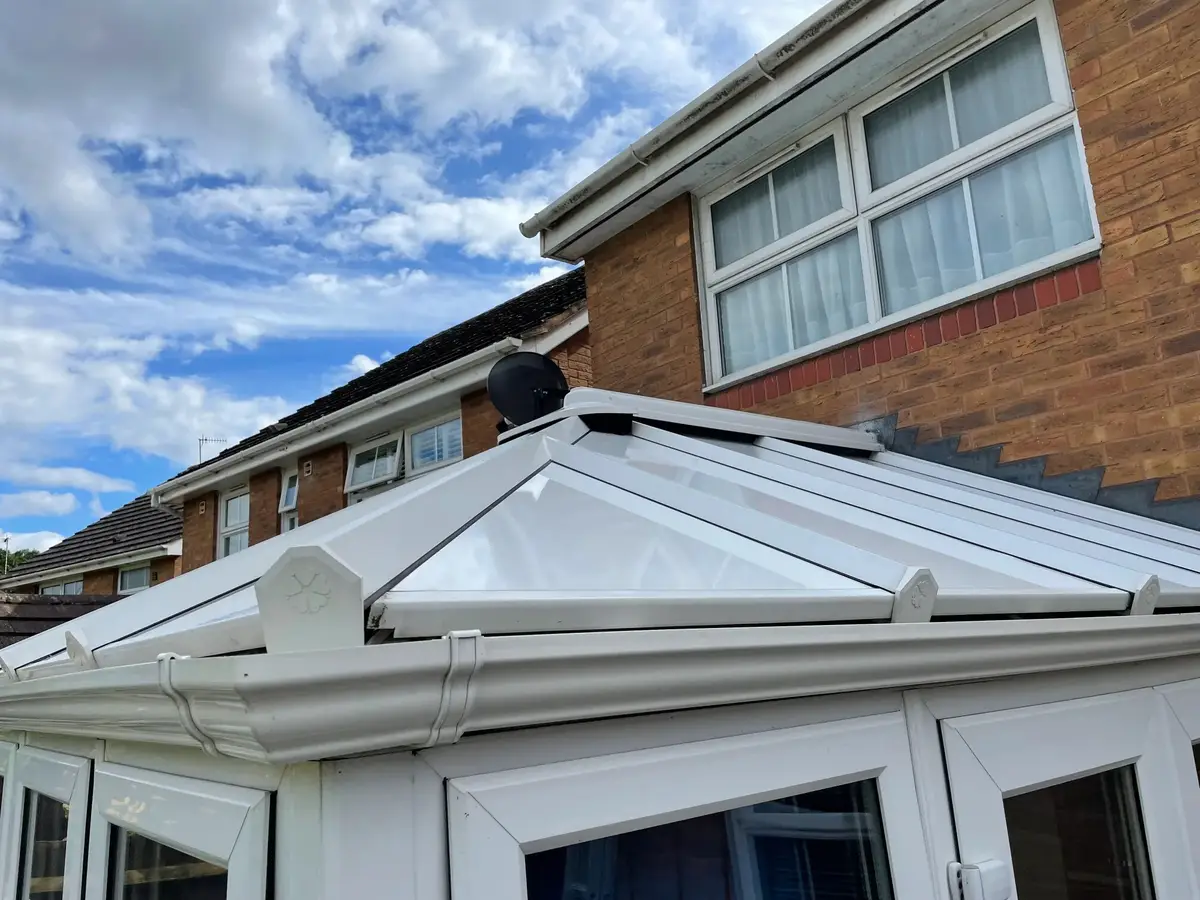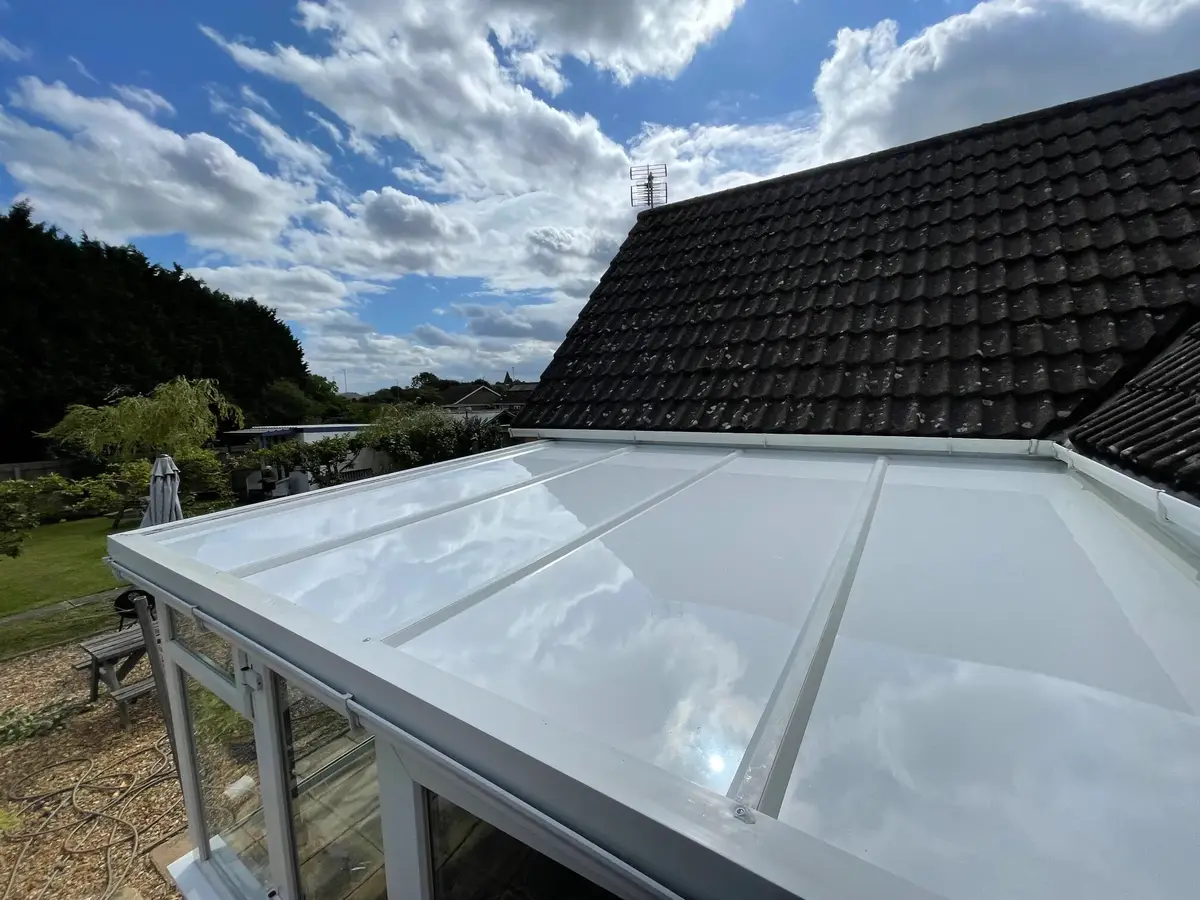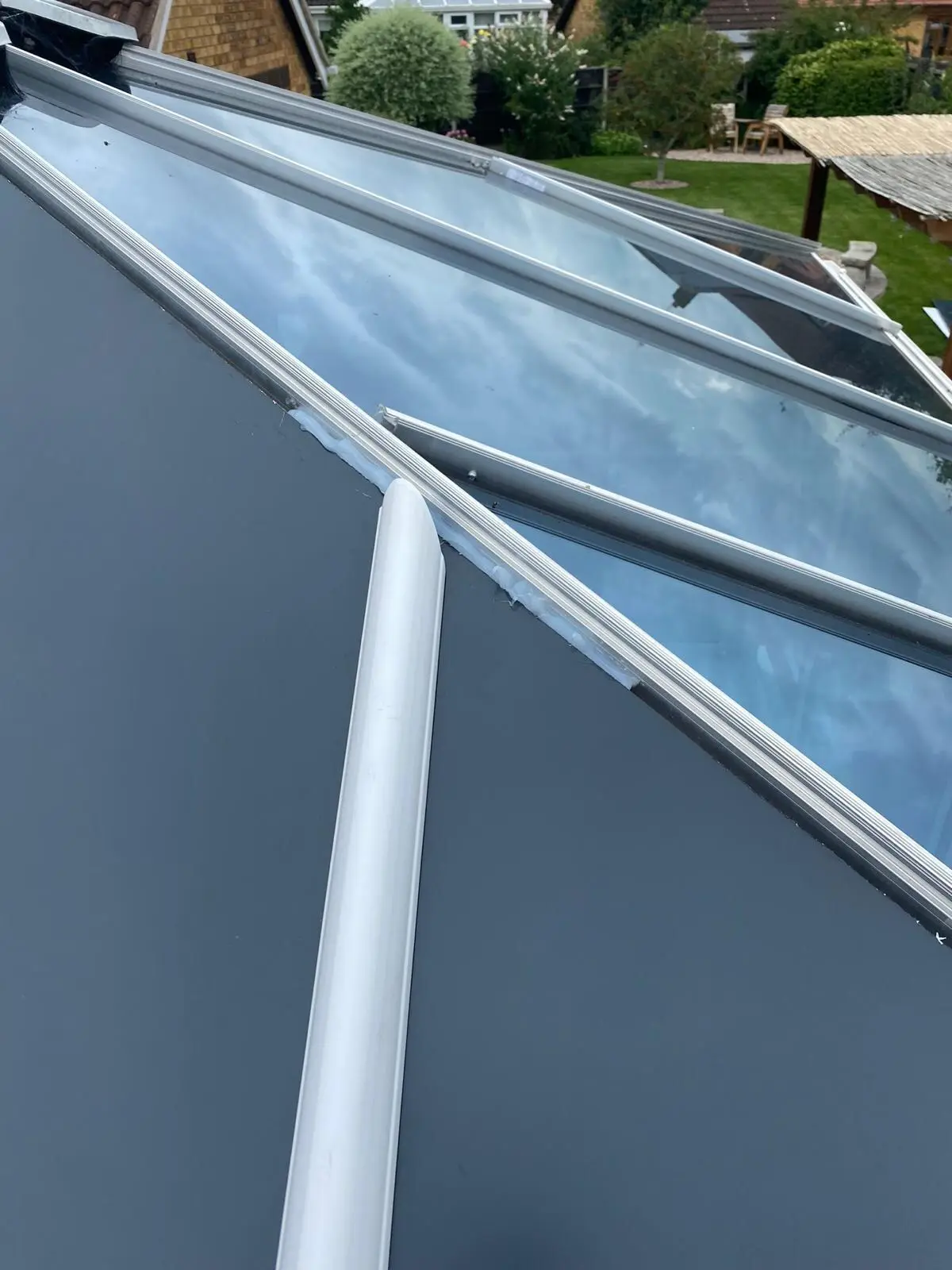
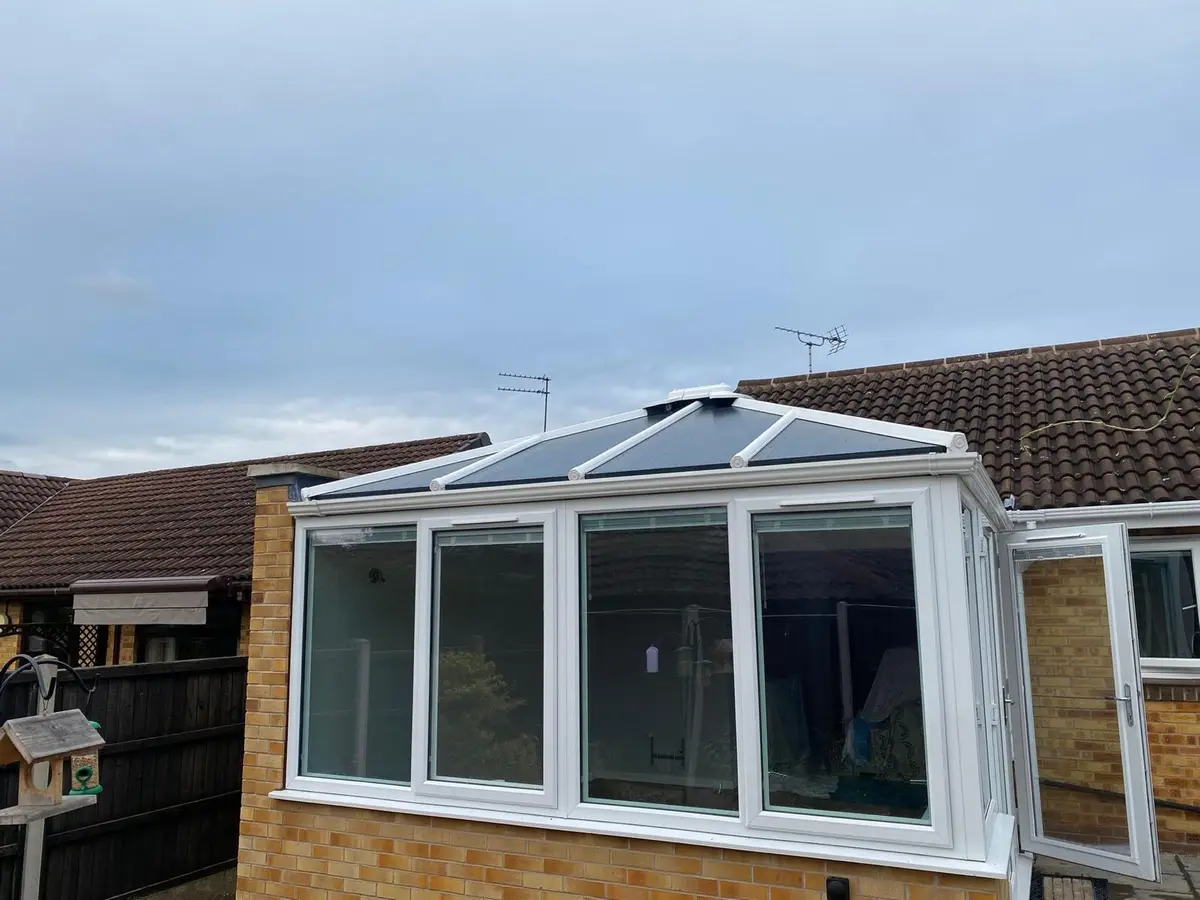
Cut the heat escaping through the roof before you buy a bigger heater. Keeping 20°C inside on a 0°C night, 12 m² of 16 mm polycarbonate overhead lets out about 552 W, and old glass about 672 W. Our 75 mm insulated panels on the same roof lose about 103 W. Rugs, draught strips and thermostats all play a part, yet the roof is the biggest leak.
The four escape routes
Heat leaves a conservatory through the roof, the glazed walls, the floor and any gaps. Warm air rises and gathers under the roof, which in most conservatories is both the largest surface and the thinnest. That explains why you can feel comfortable standing next to the heater and chilly a metre away.
The maths for any surface is short. Heat lost in watts equals U-value multiplied by area multiplied by the gap between inside and outside temperatures. The U-value tells you how many watts pass through each square metre for every degree of difference, so the lower it is, the better.
Why 20°C can still feel cold
The thermostat may say 20°C while you sit there in a jumper. Your body gives off heat to cold surfaces nearby, not only to the air. With a roof whose underside is at 15°C, your head and shoulders feel the chill even though the air around you is warm. It is also why a glass roof seems to pour cold air down: air chilled against it drops. A roof with an inner face of about 19°C gets rid of most of that feeling.
Our worked example: 12 m² of roof at freezing point
Take 0°C outdoors and a target of 20°C indoors, which is a 20 degree gap.
| Roof type | U-value (W/m²K) | Annual cost with electric heat | Annual roof heat loss | Loss through the roof on the night |
|---|---|---|---|---|
| Older glass (before 2002) | 2.8 | £456 | 1,734 kWh | 672 W |
| Polycarbonate, 16 mm | 2.3 | £375 | 1,424 kWh | 552 W |
| Polycarbonate, 25 mm | 1.6 | £261 | 991 kWh | 384 W |
| Low-e glass, current | 1.1 (1.0 to 1.2) | £179 | 681 kWh | 264 W |
| Eco Tech 75 mm panels | 0.43 | £70 | 266 kWh | 103 W |
For the annual columns we multiply U by area by 2,150 heating degree days (the average for England) by 24, then divide by 1,000, and price electricity at the Ofgem cap rate of 26.32p a unit, which runs from 1 October to the end of December 2026. Those figures assume the room stays warm all winter. Heat it only in the evening and your own numbers will be lower, but the gaps between roofs stay in proportion.
Sizing a heater
Now add the walls. A 3 m by 4 m conservatory typically has about 12 m² of glass in its sides. If that is older double glazing at about 2.8, it adds 672 W at a 20 degree gap. The floor and draughts are extra again.
- Old glazed walls with a polycarbonate roof: 552 + 672 gives 1,224 W before the floor or draughts. That calls for a 2 kW heater working hard.
- The same walls with panels overhead: 103 + 672 gives 775 W. A heater of 1 to 1.5 kW manages, switching on and off under its thermostat.
Over a four hour cold evening, the polycarbonate version needs roughly 4.9 kWh, about £1.29. The panel version needs roughly 3.1 kWh, about £0.82. Warming the room from cold adds to both, and under polycarbonate the warmth drains away faster once the heater stops.
Electric heaters compared
Every plug-in electric heater turns each unit of electricity into one unit of heat. Fan heaters, convectors, oil filled radiators and infrared panels therefore cost exactly the same per unit of warmth. The difference is in how they feel. A fan heater warms air quickly, but that air heads for the roof. An oil filled radiator is gentle and slow. Infrared panels heat you and the surfaces around you rather than the air, which works well under a cold roof.
The one that breaks the pattern is a wall mounted split unit, otherwise known as an air to air heat pump, which gives back around 3 kWh of heat for every kWh it uses. It needs fitting properly, and it performs best where the room keeps its warmth.
Low cost fixes worth doing now
- Seal the doors. Tired seals on French doors or bi-folds can let out a surprising amount of heat. Fresh brush strips and gaskets are cheap.
- Look at the join with the house. A gap at the wall plate, or flashing that has failed, lets both cold air and rain in.
- Put something on the floor. A thick rug on stone, concrete or laminate makes the room feel noticeably warmer around your feet.
- Thermal blinds and curtains. Drawn at dusk, they trap still air next to the glass. They help the walls far more than the roof.
- Fit a thermostat and timer. Warm the room for the hours you actually use it. Leaving a heater on full all day is the quickest route to a large bill.
- Keep the house door closed. If it stays open, the central heating ends up warming the conservatory as well.
Plumbing in a radiator
An exempt conservatory cannot have one. To stay outside building regulations, the room must not be heated by a fixed extension of the household central heating. Fitting insulated panels ends the exemption anyway, so find out which regulations cover your home before any radiator goes in. Our guide to building regulations for conservatory roofs has more.
In-between options
Insulation fitted inside, beneath the old roof, costs roughly £1,000 to £3,200, with about £2,850 typical. The polycarbonate stays in place and gains a layer of insulation and a ceiling underneath. It can do the job, but only with careful vapour control, as poor detailing lets moisture collect out of sight, against the cold underside of the old sheet. Compare the methods on our insulating a conservatory roof page.
For a roof 3 m by 3 m, thicker polycarbonate runs to between £2,000 and £3,500. Even at 35 mm the U-value is about 1.4, which still loses over three times as much heat as a 75 mm panel.
A roof that keeps the warmth in
The panels Eco Tech fits are made in the UK from two aluminium skins with a 75 mm solid foam core between them, which works out at a U-value near 0.43 W/m²K. Compared with 16 mm polycarbonate, that is roughly 80% less heat lost through the roof. Because the inner skin sits close to room temperature, the cold downdraught from overhead mostly disappears, and so does most condensation. Our guide on how to stop condensation in a conservatory roof explains why.
Roofs up to 12 m² start at £3,000 fitted. Between 12 and 25 m² the starting price is £4,000, and above 25 m² it is £5,000, with the HomePro 10 year insurance backed warranty included. In summer the panels also hold the heat out, and we usually fit smaller roofs in one day.
Next step
For a ballpark figure for your size and style, use our roof price calculator. For a fixed price, arrange a free survey with Eco Tech. To dig further into running costs, see what it costs to heat a conservatory.
Questions people ask
How do I heat a conservatory as cheaply as possible?
Keep the heat in first. After that, an electric heater on a thermostat, switched on only while you are using the room, is the cheapest option, unless you install a heat pump of the air to air type.
How many watts does a conservatory roof lose?
Holding 20°C indoors with 0°C outside, 12 m² of 16 mm polycarbonate gives off about 552 W. With 75 mm insulated panels the figure drops to about 103 W.
Can I insulate the roof as a DIY job?
Foil and quilt kits are sold for this, but without careful vapour control condensation builds up behind them. A fitted panel roof gets rid of the cold sheet completely.
Will a 2 kW heater warm my conservatory?
In a 3 m by 4 m room under polycarbonate on a freezing night, only just. Under insulated panels, 1 to 1.5 kW is normally plenty.