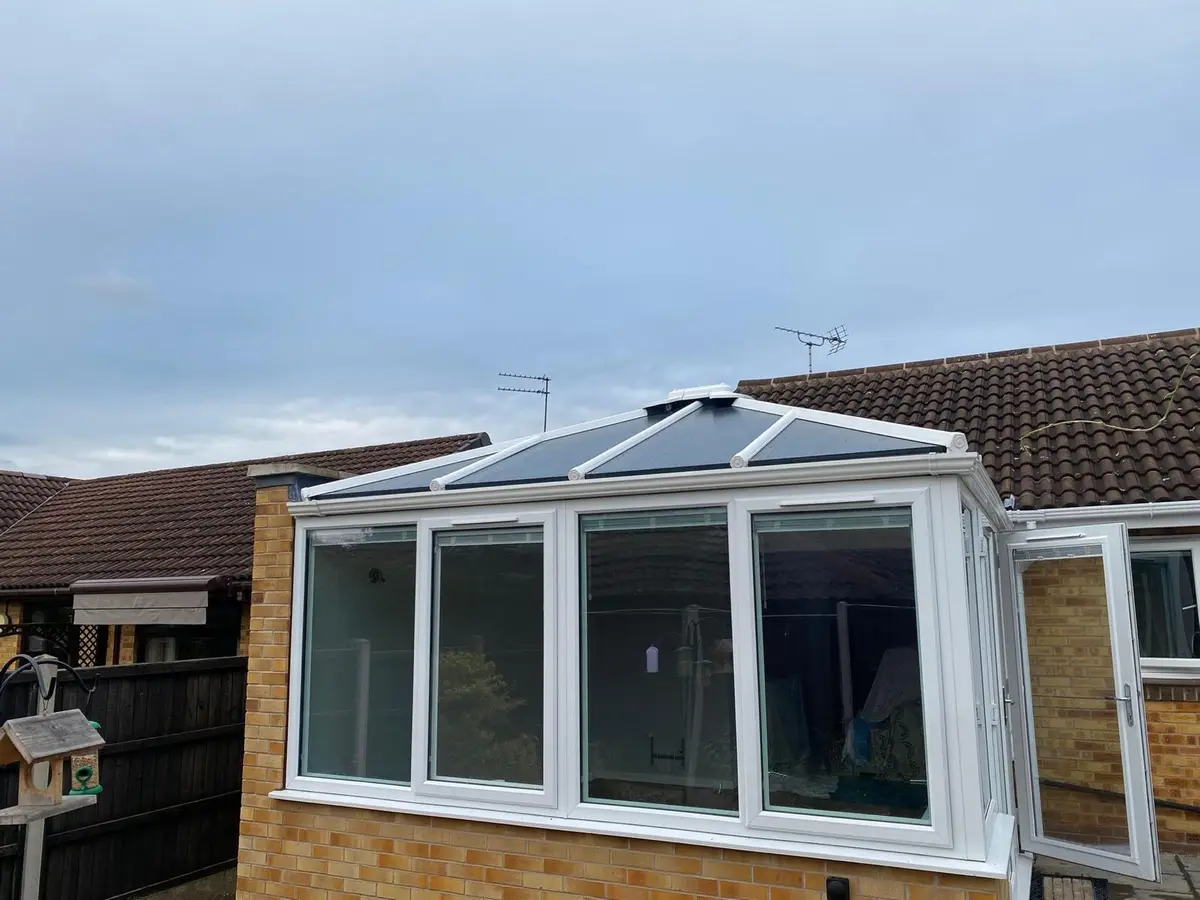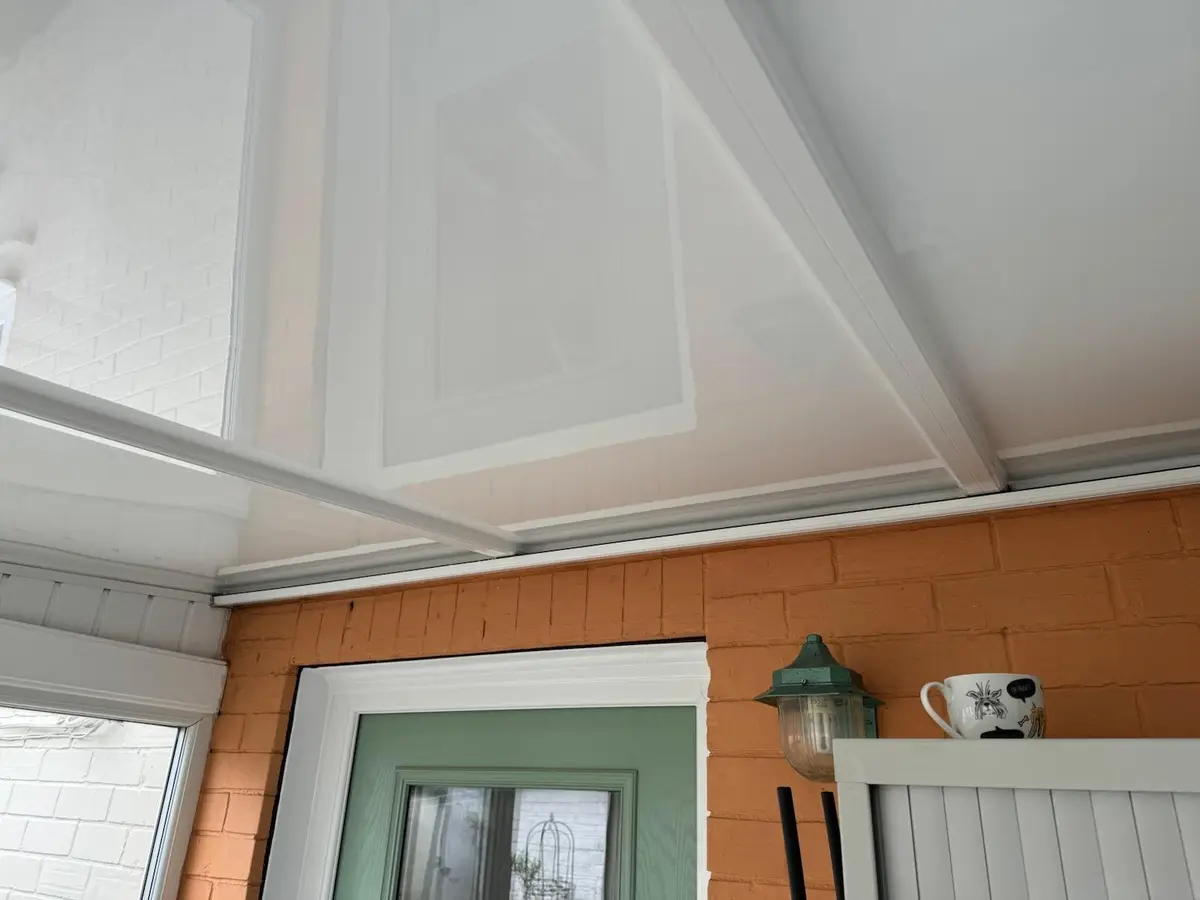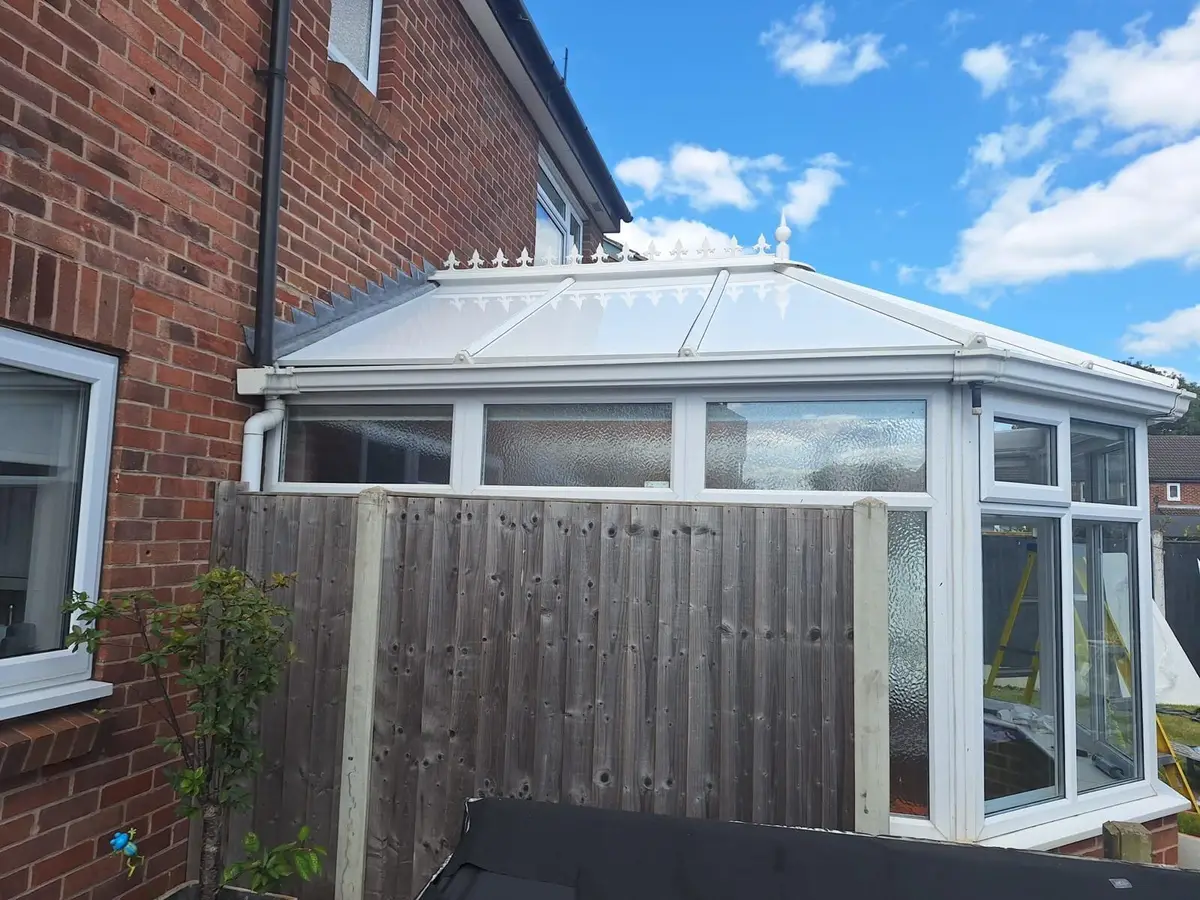
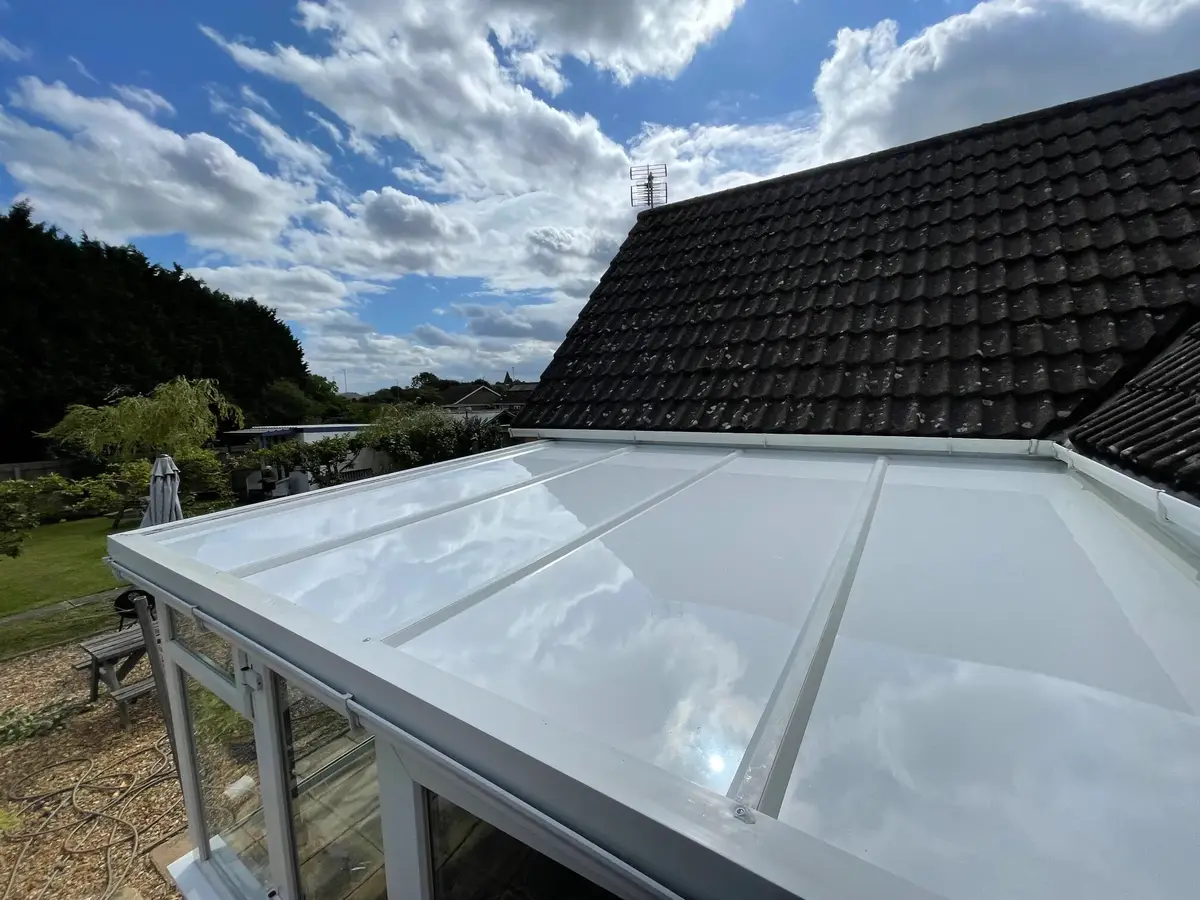
Droplets form when moist room air touches anything cooler than the air's dew point, which is about 14.4°C for air at 20°C and 70% humidity. On a 0°C night, old glass roofs cool to about 14.4°C inside and 16 mm polycarbonate to about 15.4°C, so both drip. Our 75 mm insulated panel keeps its inner skin near 19°C, and the dripping largely stops.
Damp cushions, pools of water on the sill and dark mould creeping along the roof bars are what usually prompt a call to Eco Tech. Many homeowners think the roof has sprung a leak. Quite often it has not, and the water started out inside the room. Below we show how to tell the difference and what genuinely cures it.
First, rule out a leak
- Condensation turns up on chilly mornings whether or not it rained overnight. Beads of water coat the whole underside or gather along the bars, then run downhill and fall.
- A leak shows itself while it rains or just after, normally in one place, often by the house wall, the ridge or a tired seal.
- Moisture trapped inside polycarbonate is something else again. You see rows of droplets or green growth in the hollow flutes of the sheet, which tells you the end tape or seals have given up.
For a leak, read our guide to fixing or replacing a leaking conservatory roof. Everything below deals with condensation.
Where the water vapour comes from
- Washing hung up to dry indoors, which in most houses is the largest source by far.
- Breathing, especially with the whole family round the table.
- Houseplants, which give off water through their leaves.
- Pets, aquariums and steam from the kitchen drifting in.
- Bottled gas or paraffin heaters, which release water vapour as they burn. Keep them out of a conservatory.
With a few people, a row of plants and a clothes airer, a conservatory easily reaches 70 to 80% humidity. Under old glass or thin polycarbonate, a cold night then means water.
Dew point made simple
Air holds only a limited amount of moisture, and the warmer it is the more it can carry. Cool it below its dew point against a cold surface and the surplus turns into droplets. Damper air has a higher dew point, so it takes less of a chill to reach it.
| Humidity in a 20°C room | Any surface below this temperature gets wet | What that looks like |
|---|---|---|
| 90% | 18.3°C | Washing drying with windows shut |
| 80% | 16.4°C | Busy room on a wet day |
| 70% | 14.4°C | Family meal with plants around |
| 60% | 12.0°C | Ordinary living with some airing |
| 50% | 9.3°C | Dry, well ventilated room |
How cold the underside of your roof gets
A roof's U-value decides how warm its inner face stays. Poorer insulation pulls the inside surface closer to the outdoor temperature. The figures below are calculated for a room at 20°C using the standard surface resistance for roofs.
| Roof type | U-value (W/m²K) | Inside face, 0°C outdoors | Inside face, minus 5°C outdoors | Room humidity that wets it at 0°C | Room humidity that wets it at minus 5°C |
|---|---|---|---|---|---|
| Glass fitted before 2002 | 2.8 | 14.4°C | 13.0°C | 70% or so | 64% or so |
| Polycarbonate, 16 mm | 2.3 | 15.4°C | 14.3°C | 75% or so | 70% or so |
| Polycarbonate, 25 mm | 1.6 | 16.8°C | 16.0°C | 82% or so | 78% or so |
| Current low-e glass | 1.1 | 17.8°C | 17.3°C | 87% or so | 84% or so |
| Eco Tech 75 mm panel | 0.43 | 19.1°C | 18.9°C | 95% or so | 94% or so |
Older roofs do worse in practice than these numbers suggest, for two reasons. Under a clear sky the roof loses heat by radiation, so its outer face falls below the air temperature. And aluminium bars carry cold much better than the sheets around them, so they run colder still. That is why the first drips usually appear along the bars.
Cheap fixes worth trying first
- Let air through. Every day, open the roof vent and trickle vents for a spell, winter included. Swapping moist indoor air for drier outdoor air costs nothing.
- Dry clothes somewhere else. If there is no other option, run a dehumidifier while they dry.
- Run a dehumidifier. A compressor unit using about 200 W for 8 hours takes 1.6 kWh, roughly 42p at the 26.32p per kWh electricity cap for October to December 2026.
- Keep the heat even. Quick blasts warm the air and load it with moisture, then the cold roof chills it and it drips. A gentle, constant setting works better.
- Dry the bars each morning. It cures nothing, but it holds mould back and spares the frame seals.
When condensation starts causing harm
The odd drip on a frosty morning is just irritating. Month after month of it does damage. Look out for black spots of mould on the bars and seals, window boards that swell or stain, damp patches in the plaster of the dwarf wall and a stale smell after the room has been closed up. Rugs and wooden furniture under the worst spots will stain and eventually rot.
Treat mould on the seals promptly, because it ages them and can let rain through later on. If the signs return each winter however well you ventilate, the roof is the cold surface behind them, and replacing the roof is what puts a stop to it.
Can insulating a conservatory roof make condensation worse?
Yes, if it is done badly. Foil, quilt or boards fixed inside under an old polycarbonate roof leave that sheet just as cold. Warm moist air that slips past the insulation then condenses on the hidden sheet. The water soaks into the insulation, leaks out round the sides or grows mould. A good internal system relies on an unbroken, sealed vapour control layer on the room side. Our page on insulating a conservatory roof explains what proper internal work involves.
A panel roof sidesteps the issue altogether. No cold sheet remains overhead. The panel itself is the roof, made in the UK from two aluminium skins bonded to 75 mm of solid foam, and there is no hollow space for moist air to get into.
Life under an insulated panel roof
Because the inner skin holds at about 19°C even on a freezing night, the air would have to reach around 95% humidity before the panels became damp. Everyday living does not get there, so condensation on the roof largely stops.
Keep expectations realistic for the rest of the room. The window frames and glazed walls stay as they are, and older double glazing can still fog over on the very coldest mornings if the air is humid, so carry on airing the room. Taking away the cold roof removes the largest cold surface, and that cuts the amount of water that collects on the walls too.
Eco Tech roofs start from £3,000 fitted for up to 12 m² and from £4,000 for 12 to 25 m². The price covers taking the old roof away and the fitting, with a 10 year insurance backed warranty through HomePro, and most roofs are fitted in a single day.
Ending the drips
If your roof drips every winter, swapping polycarbonate for insulated panels is the permanent cure. Try the roof price calculator for a range, or ask for a free quote by sending a few photos and measurements.
Questions people ask
Why do my polycarbonate sheets have water inside them?
Moisture in the hollow flutes tells you the breather tape or end seals have broken down. You cannot wipe it out, and it normally means the sheets are due for replacement.
Can a dehumidifier stop condensation on my conservatory roof?
It makes a big difference in a damp room, costing about 42p to run a 200 W unit for 8 hours. It cannot warm the roof, though, so a few drips may still form on the coldest nights.
Do insulated roof panels suffer from condensation?
Hardly ever. With 20°C indoors and 0°C outside, the panel underside holds at about 19°C, near room temperature, so moisture rarely settles on it.
Does condensation mean I need a new conservatory roof?
Not by itself. Alongside leaks, yellowed sheets or water in the flutes, it usually does. Our list of signs a conservatory roof is worn out helps you decide.