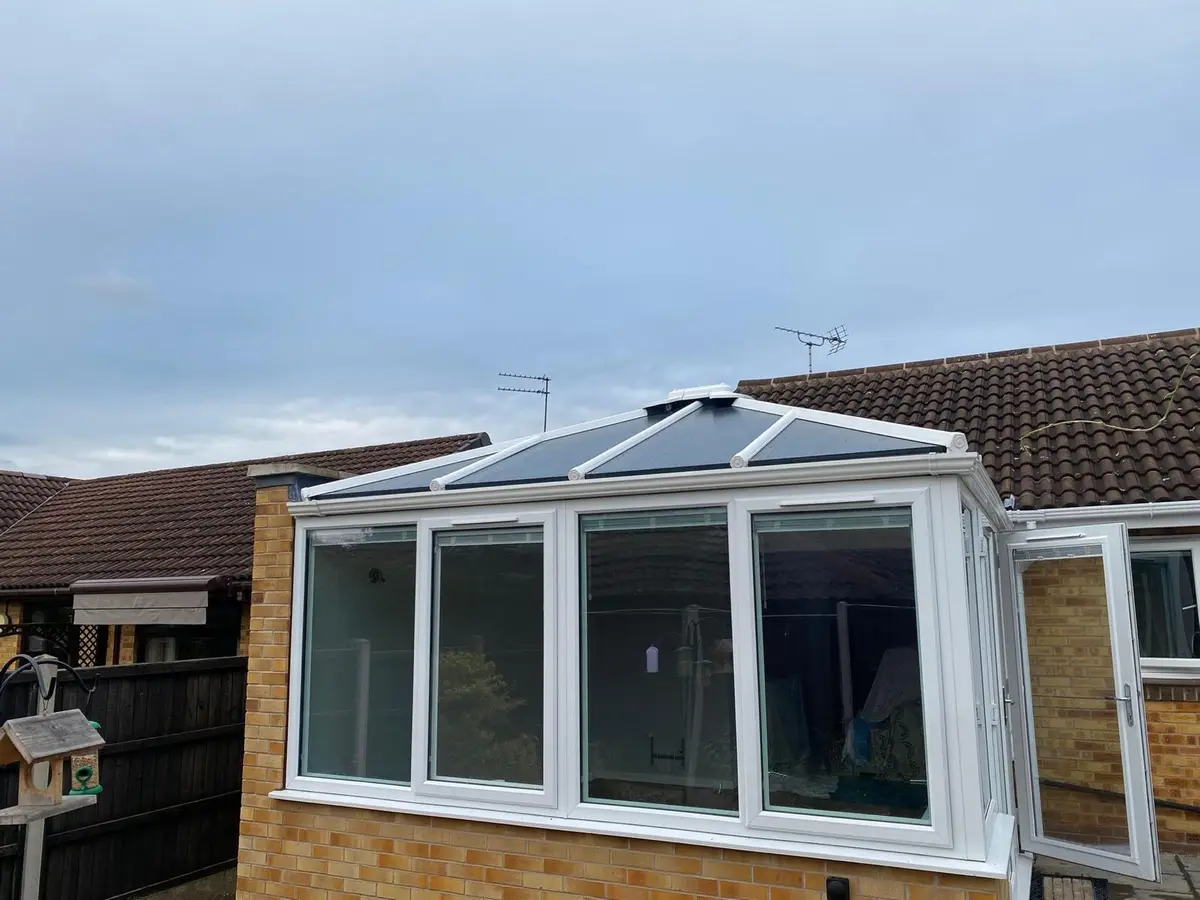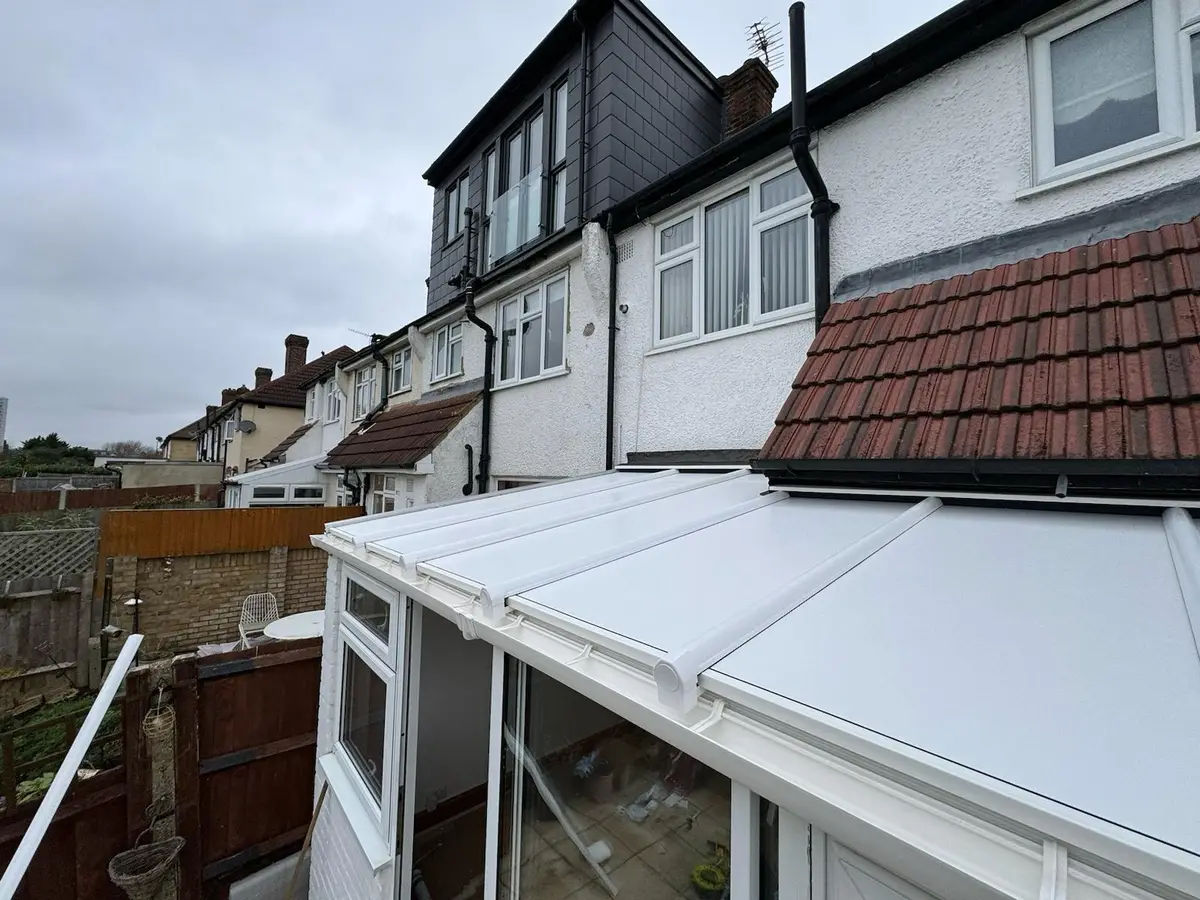
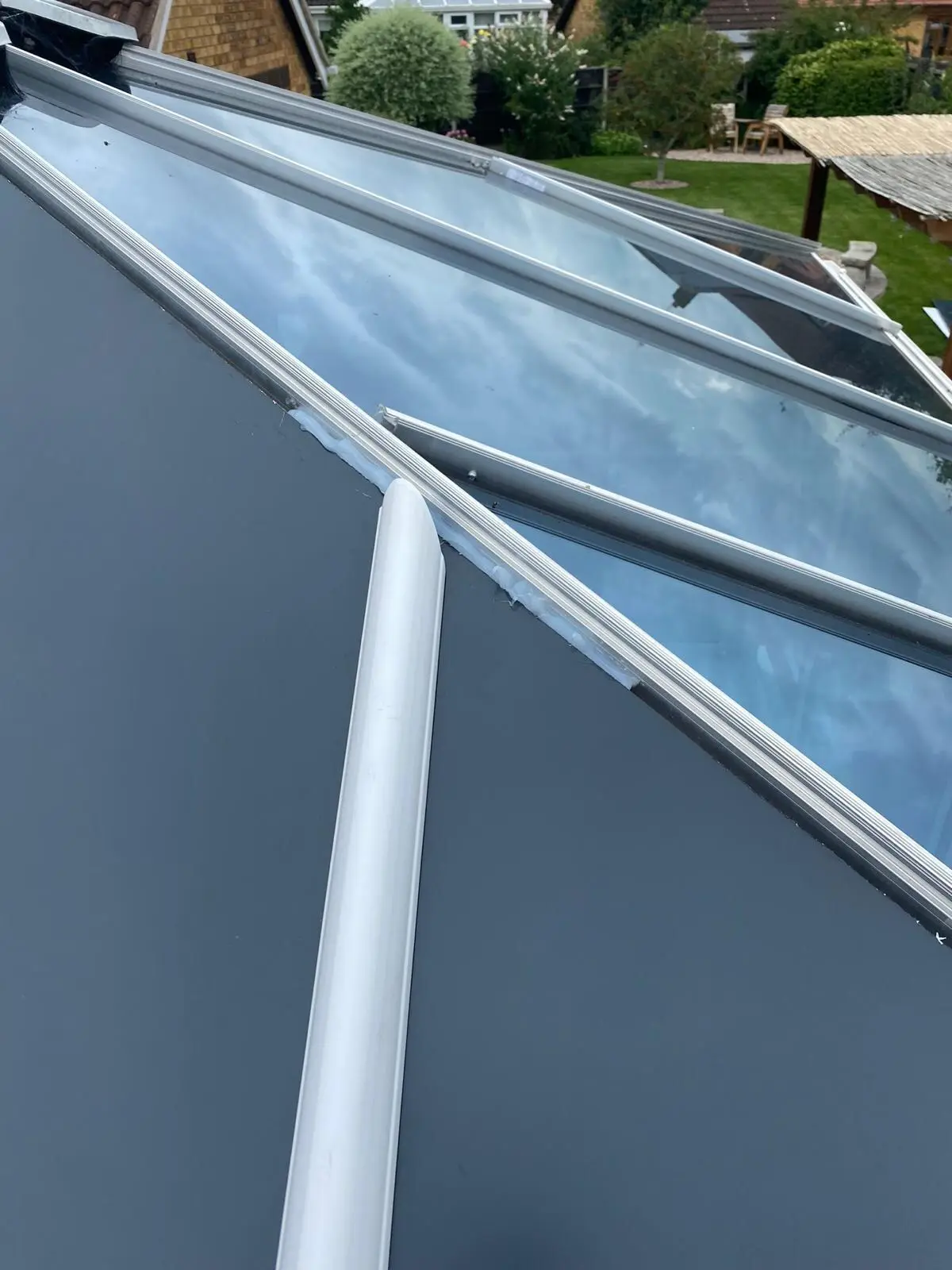
Most of the heat arrives through the roof, so start there. A glass or polycarbonate roofed conservatory often climbs past 35 to 40°C on a sunny afternoon. Vent at high and low level, shade the glass from outside where possible and choose a fan over a portable air conditioner. For a permanent answer, we fit insulated panels, so no direct sun passes through the roof.
Where all that heat comes from
Around midsummer the sun stands high over the UK at lunchtime, so its rays fall nearly straight onto the roof instead of the walls. In clear weather that is roughly 800 W of sunshine on each square metre. At its peak, a 12 m² roof is collecting something near 9,600 W.
Suppose a tinted glass or polycarbonate roof passes only half of that. The room still takes on the output of two or three fan heaters running flat out, hour after hour. Sunlight strikes the floor and the furniture and becomes heat, and that heat finds it much harder to leave through the glazing than the light found it to get in. Doors and windows are seldom opened wide enough to clear it.
The direction the room faces makes a big difference. South and west facing conservatories have it worst, and a west facing one usually peaks from about 3pm to 7pm. East facing rooms warm up early and settle by lunchtime. North facing rooms seldom overheat badly, though a heatwave can still make a polycarbonate one unpleasant.
Why the roof, not the walls, is the problem
Low morning and evening sun comes in through the side glazing at an angle that wall blinds handle well. High summer sun comes straight through the roof, where shading is awkward and blinds sit inside the glass. That is why a conservatory can be fine at 8am and unusable by 2pm, and why the roof is where we focus.
Things to try today that cost nothing
- Ventilate before it warms up. Get the roof vent and windows open while the roof is still in shade, not once the thermometer reads 30°C. Keeping heat out is much easier than getting rid of it.
- Use a high opening and a low one. Warm air climbs. A roof vent or top light lets it escape, while an opening near the floor on the far side draws in cooler air behind it. That draught moves far more heat than a single open window.
- Shut the house off. Close the door between conservatory and house through hot afternoons so the warmth stays out of the other rooms.
- Close up at dusk only when inside is cooler. On a warm night, leave vents open (if it is safe to) so the next morning starts lower.
- Watch the heat stores. Dark rugs and cushions left in sunshine, and stone floors, soak up heat and release it for hours. Pale colours help slightly.
Paid fixes compared
| Option | Rough spend | Effect | Drawback |
|---|---|---|---|
| Desk or pedestal fan | Low | You feel cooler, the air temperature stays the same | Works only for whoever sits in the breeze |
| Blinds fitted under the roof | Medium | Good on glare, small effect on heat | The heat has already passed the glass, so the room still warms |
| Solar film on a glass roof | Medium | Bounces back some sunlight | Makes the room dimmer and may affect some glass guarantees |
| Opal or solar control polycarbonate | Medium to high | An improvement on clear sheet | Solar heat still gets in, and it is weak in winter |
| Portable air conditioning unit | Medium, then running costs | May keep the room a few degrees lower | Loud, needs a hose through a window, outmatched by a glass roof |
| Eco Tech insulated panel roof | Fitted prices from £3,000 | No direct sun through the roof at all | Less daylight |
Fan or air conditioner: what they cost to run
Under the Ofgem price cap that runs from 1 October until 31 December 2026, a unit of electricity costs 26.32p. A 40 W pedestal fan left on for 8 hours takes 0.32 kWh, roughly 8p a day. A portable air con unit pulling about 1 kW for 6 hours takes around 6 kWh, so about £1.58 a day.
That £1.58 does not go far. The unit is up against several kilowatts of sunshine through the roof, while single hose models replace the air they blow out with warm air drawn in from outdoors. On a bright afternoon in a glass or polycarbonate room, most only blunt the heat.
The trouble with blinds inside the roof
Roof blinds are a popular buy and they do tame glare. The catch is where the energy goes. Sun passes through the sheet, lands on the blind and heats it, and the warm blind then heats the room air. The sun on your skin eases, but the temperature keeps rising.
Shade works properly only on the outside of the glazing, where the heat never gets in. That is hard to arrange above a conservatory, so many people end up replacing it.
What we fit instead
Eco Tech removes the polycarbonate or glass and fits UK made insulated roof panels: a 75 mm core of solid foam bonded between two aluminium skins. Direct sun cannot pass through. The top skin warms in sunshine, but the foam keeps that heat away from the room, and the white underside stays near room temperature.
Your glazed walls are untouched, so sun still reaches you through them, mainly in the morning and evening when it sits lower. Wall blinds cope with that easily because of the angle. Most customers add one or two roof lights to keep the room bright. These let a little sun in, but across a small part of the roof instead of the whole of it.
The same roof holds warmth in winter. Holding 20°C indoors when it is 0°C outside, a 12 m² roof made of 16 mm polycarbonate lets out about 552 W, compared with about 103 W through panels. Our guide to a conservatory too cold in winter covers that side.
Price and fitting time
A roof up to 12 m² starts at £3,000 fitted. Medium roofs between 12 and 25 m² start at £4,000, and roofs over 25 m², including P-shapes, at £5,000. We include taking away the old roof, panels in your chosen colour, fitting and the HomePro 10 year insurance backed warranty. Most households spend between £3,000 and £7,500, and we usually fit a small lean-to or Edwardian in one day.
To see a range for your own roof, try our roof price calculator.
Keeping the old roof? A plan for a scorching day
- By 9am: roof vent open, plus a low window on the opposite side.
- Mid morning: pull the roof blinds fully closed on the sunny side.
- From noon to late afternoon: keep the house door shut and sit by a fan.
- Evening: throw everything open once it is cooler out than in.
On most days that keeps a polycarbonate room bearable. On the very hottest days it will still be too warm to sit in.
Next step
If the conservatory goes unused every summer, book a free Eco Tech survey. Send us a few photos and measurements first if you like, then we visit to look over the frame, take measurements and put a fixed price in writing.
Questions people ask
How can I stop the sun coming through my conservatory roof?
Outside shading is difficult on a conservatory roof, and film on glass only helps a little. Once the roof is changed to insulated roof panels, no direct sun gets through it.
What temperature can a conservatory reach in summer?
With a polycarbonate or glass roof, 35 to 40°C on a sunny day is common, particularly when the room faces south or west.
Do roof lights in a panel roof let the heat back in?
Far less than the old roof did. One or two roof lights take up a small share of the roof, and the rest is solid and insulated.
Will a fan lower the temperature in a conservatory?
No. It cools you by moving air across your skin, but the room stays the same temperature. Running one costs roughly 8p a day.