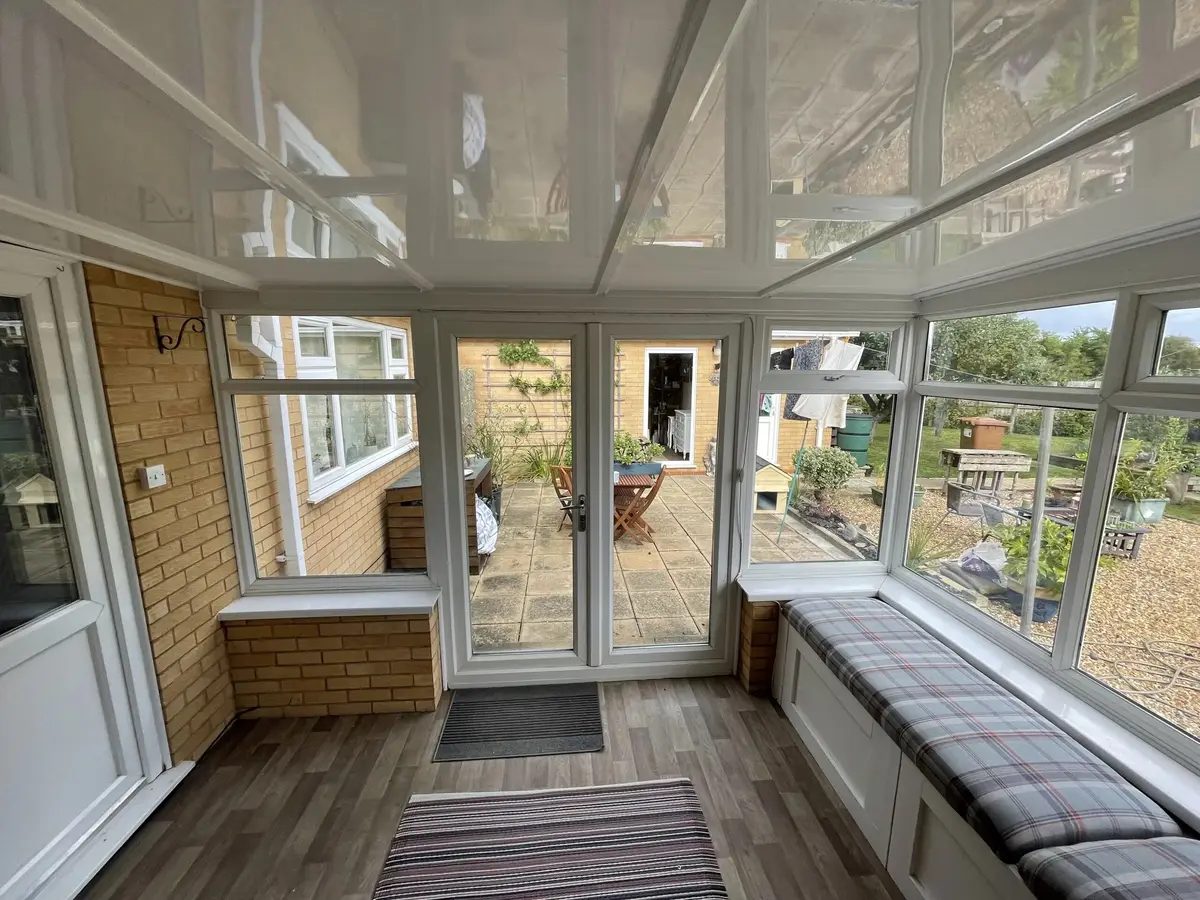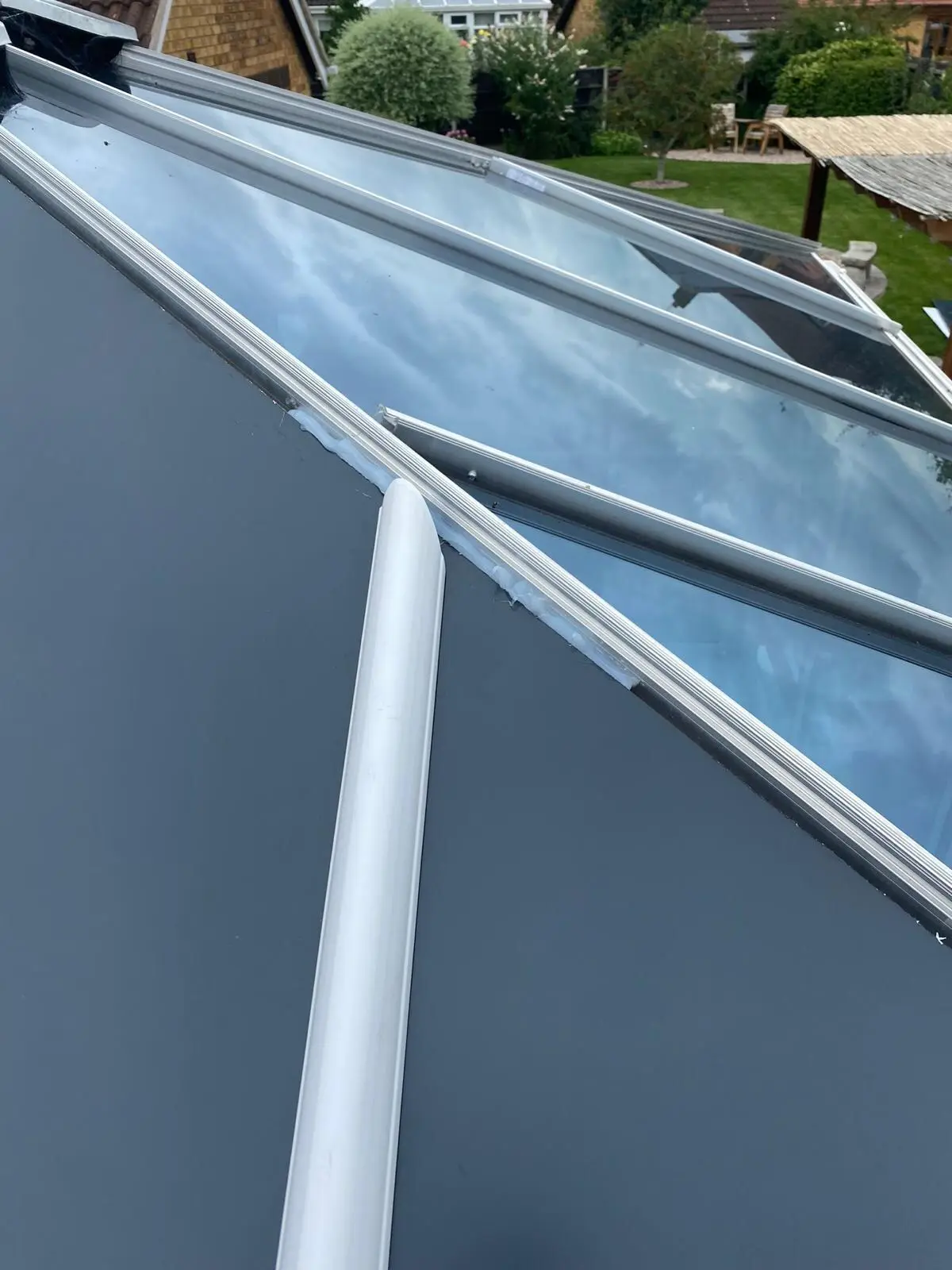
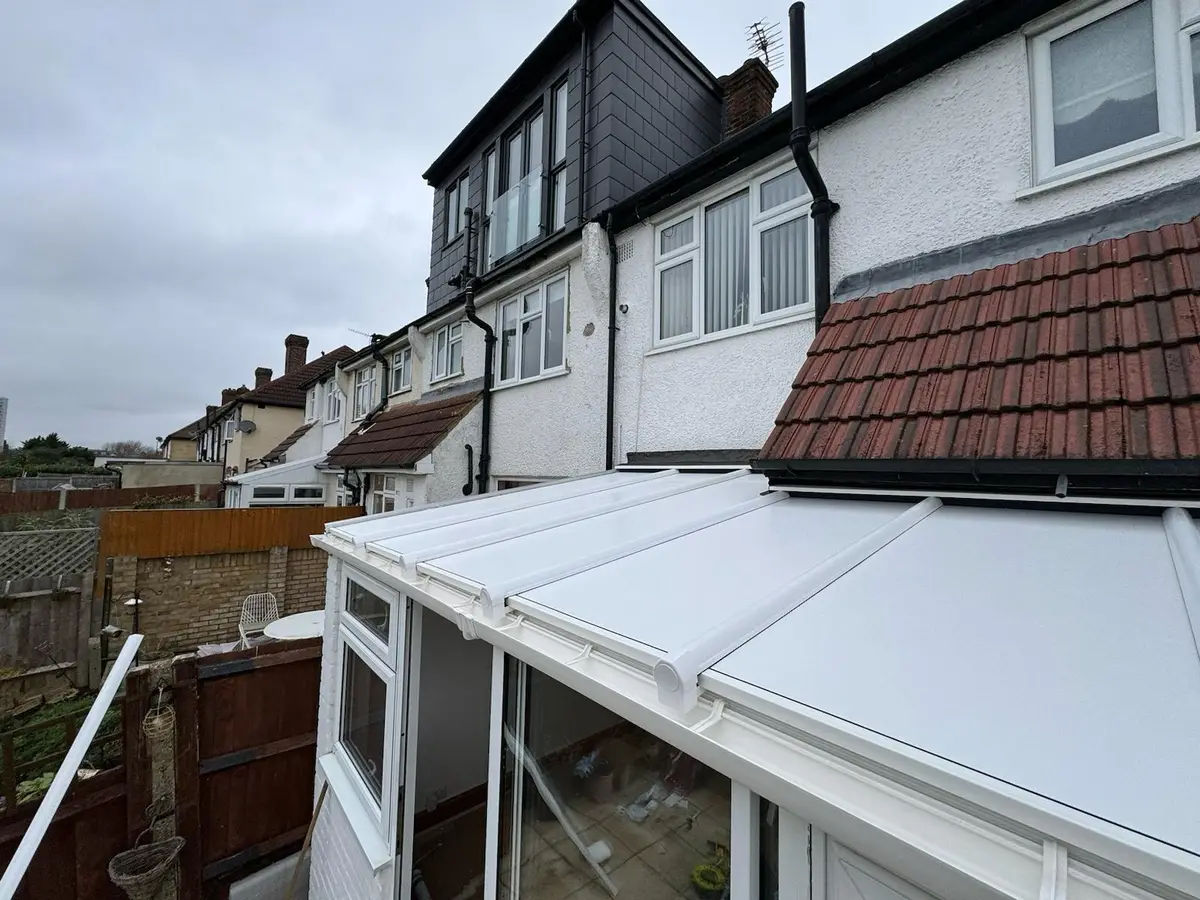
Yes, a little, and we tell every customer so at survey. Insulated panels block the light from overhead, but the glazed walls stay put. A 3 m by 4 m conservatory still has roughly 12 m² of glass in its sides, far more than a normal lounge window. Adding one or two roof lights, £395 each, returns daylight from above where you need it.
The short version from Eco Tech
We have fitted panel roofs for more than 15 years, and the question we hear most at survey is whether the room will turn gloomy. It will not, but it does change. You swap light from above for light from the sides, and you lose the glare that comes with it.
The rest of this page walks through the numbers, the rooms that feel the change most, and the simple things we suggest to keep the space bright.
Doing the sums on daylight
Overhead glazing looks up at the sky where daylight is strongest, so a clear or polycarbonate roof pours light straight down. Once panels go on, that source is gone. You notice it most late on a grey December afternoon, and on a sunny July day you mainly notice that you are no longer squinting.
Now count the glass you keep. Picture a lean-to measuring 4 m wide and 3 m from the house. Its three outer sides add up to 10 m in length. A dwarf wall of roughly 0.6 m with eaves near 2.1 m gives 1.5 m of glazing height, so about 15 m² of window before you subtract the frames. Take the frames off and around 12 m² of clear glass remains.
An ordinary sitting room window holds perhaps 2 to 3 m² of glass. Even under an opaque roof, then, that lean-to keeps somewhere between four and six times as much glass as a standard room in the house. It reads as a bright room with a ceiling, not a cave and not a greenhouse.
Orientation changes the picture
| Direction it faces | Under the old see-through roof | Under our insulated panels |
|---|---|---|
| South | Glaring and frequently far too warm | Plenty of light through the sides and much easier to sit in. Roof lights are a choice, not a need. |
| West | Harsh sun from mid afternoon into the evening | Low evening sun still reaches you through the side glass. A single roof light normally does it. |
| East | Sunny early on, cooler after lunch | Lovely in the morning. Place a roof light by the house wall for later in the day. |
| North | Gentle, steady light and seldom overheats | This is where the difference shows most. Plan two roof lights and decent lighting. |
A north facing room that never gets too hot deserves a second thought. If your reasons are cold winters, dripping condensation or noisy rain, panels still earn their place, but build the roof lights into the plan from day one.
The spots that lose the most light
With a panel roof the daylight enters through the walls, so the dimmest corner shifts to the back of the room, against the house and furthest from the glass. The room behind, which is often a kitchen or dining area opening through patio doors, also borrows less light than it did.
People rarely think of that kitchen until afterwards. If it depends on light passing through the conservatory, ask us to place a roof light right beside the house wall. No other position does as much.
Choosing roof lights
Our roof lights and spotlights are glazed units set into the panel roof, and they are priced at £395 each, fitted with the roof. Most households pick one or two.
A useful rule: glass in a roof admits roughly double the daylight of an upright window the same size, because it is angled towards the open sky overhead. That means a modest roof light punches above its size.
- A single unit: near the house wall over the dimmest area, or above where the dining table stands.
- A pair: one by the house wall and one above the sofa, or spread along the length of a long lean-to.
- Three or more: seldom a good idea. Each one lets in a little summer heat and lets out a little winter warmth, which are the problems the new roof is there to solve.
Getting more from the remaining light
- A white ceiling. Every panel we fit is white on the inside as standard, whatever colour you pick for the outside. That pale surface spreads wall light across the room.
- Pale walls and floors. A light painted house wall and a light floor bounce back far more than bare brick or dark timber.
- Clear glass. Wall blinds left half closed all day cost you a lot of light. Once the roof stops the overhead sun, many people barely use them.
- One well placed mirror. Hung opposite the garden on the back wall, it pushes light into the back of the room.
After sunset
A see-through roof gives you nowhere sensible to mount a light fitting, so most conservatories rely on a lamp in the corner. Panels create a real ceiling. We can fit LED spotlights into it for £345, and with a dimmer the room works as well at 9pm in January as it does at noon in June. The roof panel price list shows the extras together.
How people end up using the room
In our experience it gets used more, not less. Under glass, a laptop screen is hard to read at lunchtime and the room is too dim once the sun drops. Under panels the light stays even through the day and the spotlights take over at night. Plenty of customers move a desk or a dining table in within weeks.
Weighing it up honestly
Take a typical 12 m² roof. You lose daylight from above. You gain a roof that lets out about 103 W when it is freezing outside rather than about 552 W (75 mm panels against 16 mm polycarbonate), no direct sun through the roof in summer, far less condensation and rain that sounds like a quiet hush. Screens become readable at midday and sofas and rugs fade more slowly.
For a family using the room daily, we think that is a sound exchange. If you mostly sit out there to watch the clouds, it might not be, and we would sooner say so at survey than after fitting.
Try it before you decide
If your roof has blinds, pull every one shut on a sunny day and spend an hour in the room. That is close to how panels without any roof lights feel, though the real thing is lighter because a white panel ceiling reflects better than fabric. Next, open a single blind by the house wall. That shows you what one roof light adds.
Where to go from here
When Eco Tech surveys your home we note which way the room faces and what sits behind it, then suggest where roof lights would earn their keep. You can price the roof with and without them on the roof price calculator, or ask us for a free survey and a fixed written price. For a wider comparison, read polycarbonate against insulated roof panels.
Questions people ask
Will my conservatory lose light with a panel roof?
Some, because light no longer comes through from above. The side glazing stays, and one or two roof lights restore overhead daylight.
What number of roof lights do most people choose?
One or two. If you only have one, put it close to the house wall, where the room is dimmest and where it also helps the room behind.
Is it possible to fit ceiling lights in the new roof?
Yes. We can set LED spotlights into the panel ceiling for £345.
Are the panels white on the underside?
Yes, white inside as standard, so daylight bounces around the room. Outside you can have any RAL colour, and anthracite grey and white are the two most chosen.