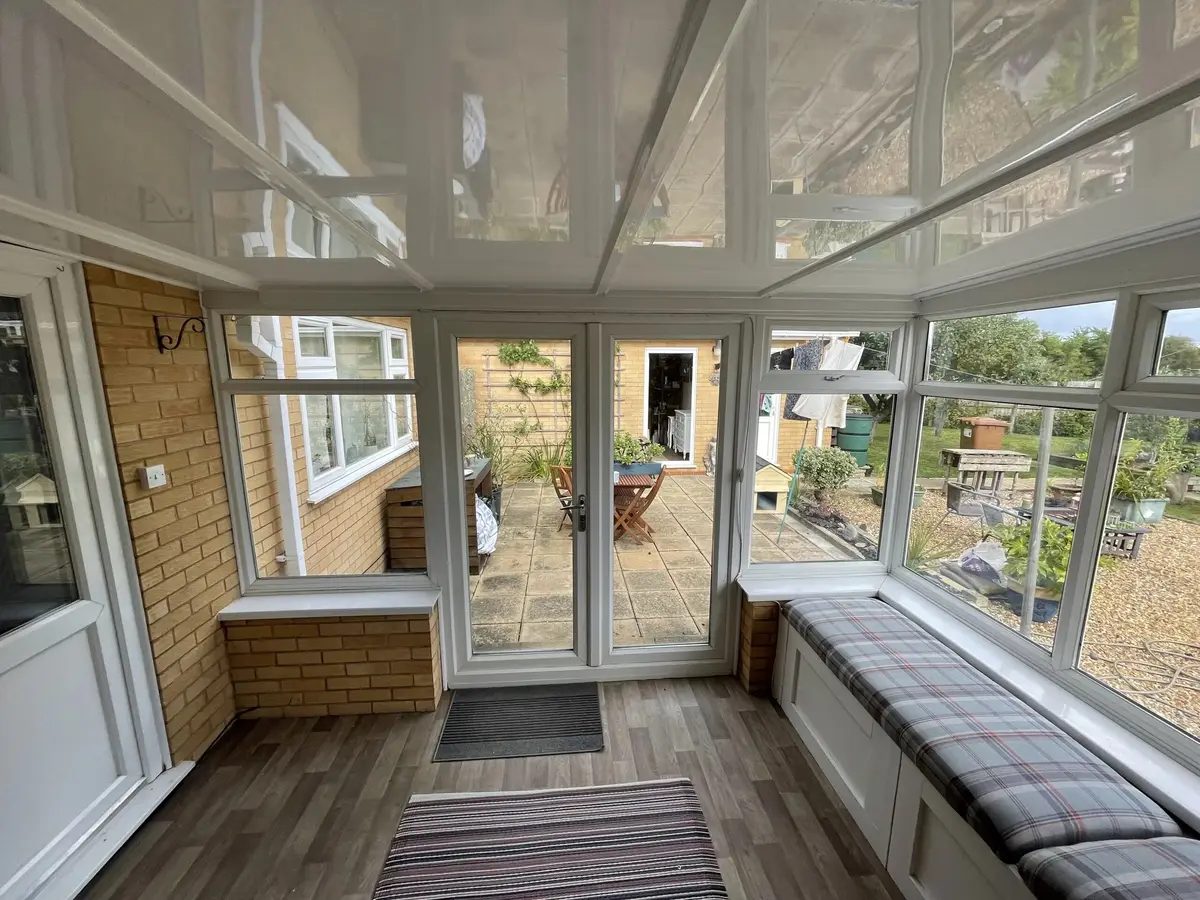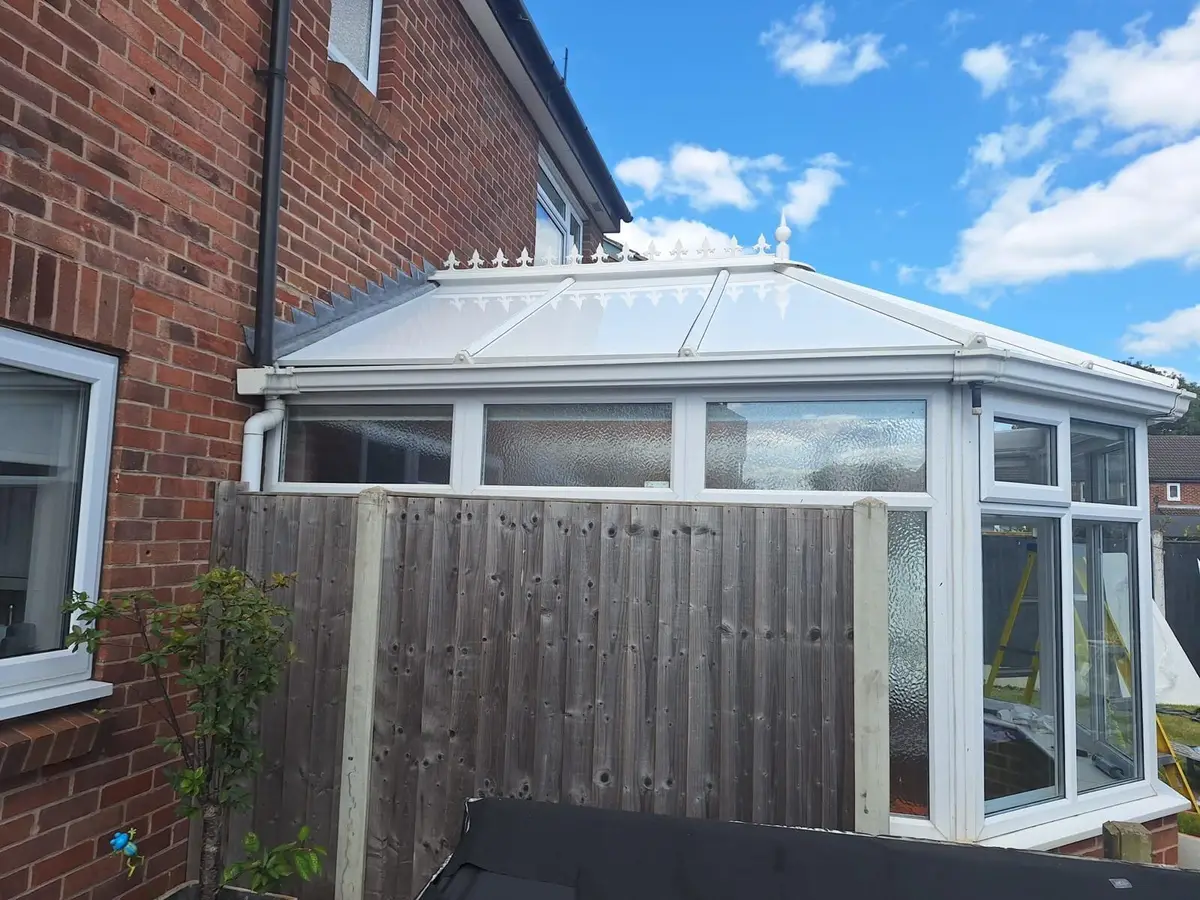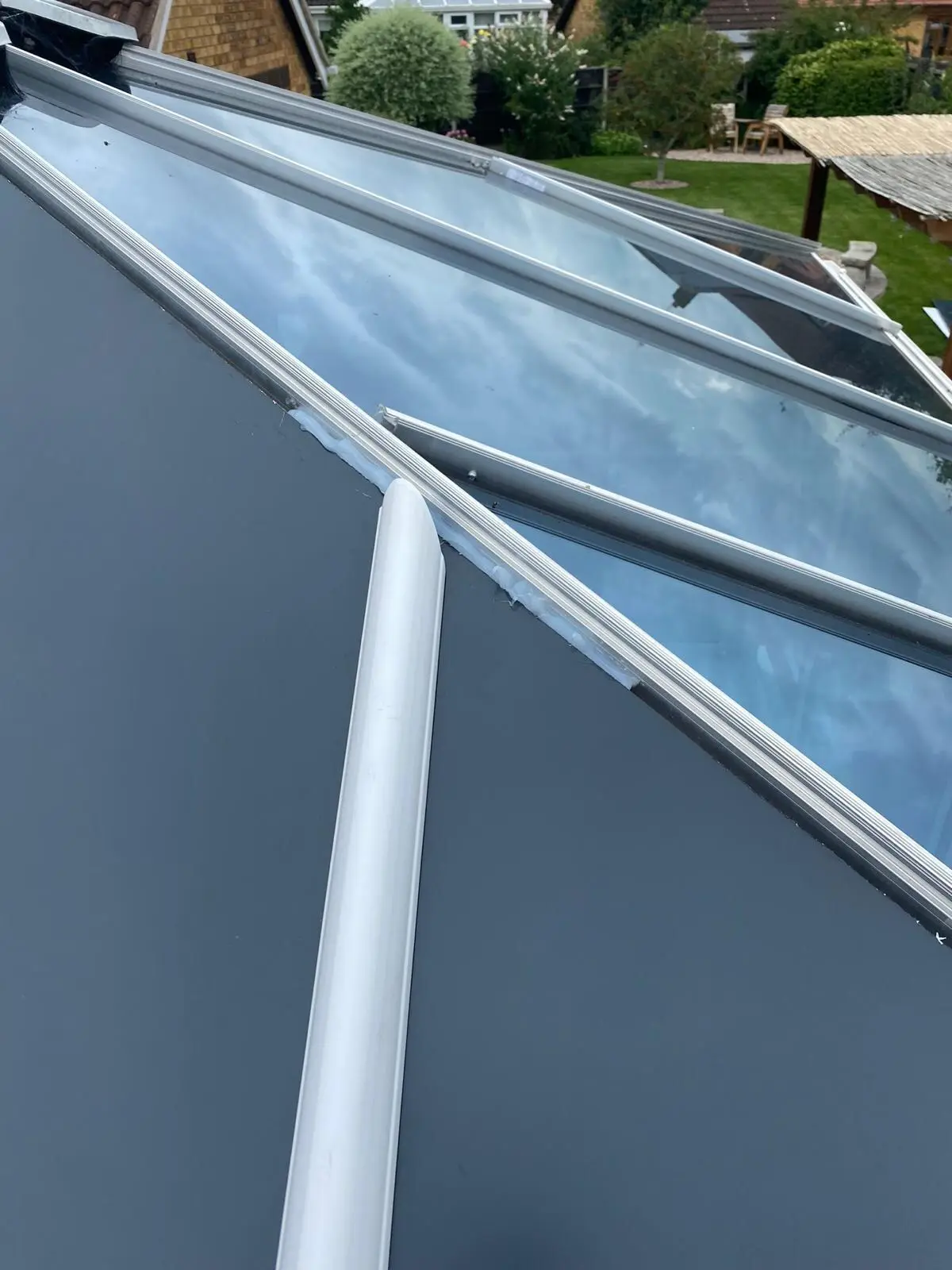
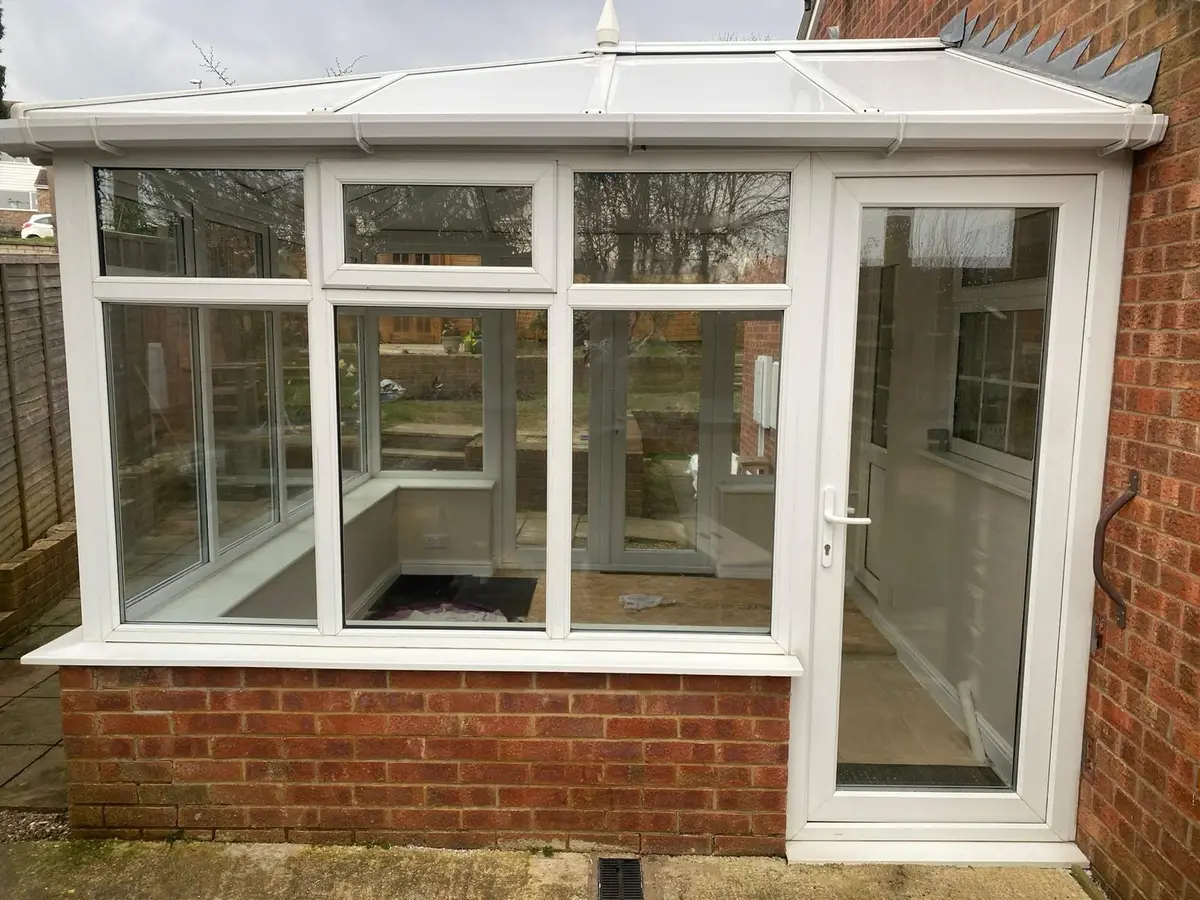
Polycarbonate is thin, light and full of hollow channels, so every raindrop sets it vibrating like a drum. Heavy rain, which the Met Office defines as over 4 mm an hour, lands around 48 litres an hour on a 12 m² roof. Rugs and blinds soften things slightly. Our 75 mm foam filled panels stop the drumming where it starts.
Why a plastic roof is so loud
Think of each drop as a small tap with a hammer. A heavy roof soaks that energy up. Multiwall polycarbonate is stiff and very light for its area, so each tap makes the sheet bend slightly and ring. Its hollow flutes behave like little sound boxes, passing the vibration from one end of the sheet to the other.
The volume of water explains the rest. At 4 mm an hour, the point the Met Office calls heavy rain, each square metre takes 4 litres an hour. A 12 m² roof is hit by 48 litres an hour, arriving as millions of separate drops. Hailstones are louder still, since each one carries far more energy than a drop of rain.
Glass weighs more than polycarbonate, so rain on a glass roof is usually less of a racket, although hail on glass still cracks sharply. Weight plus a soft, damping layer inside the roof is quieter again, and that is how our panels are built.
Does it really matter how loud it is?
We measure loudness in decibels, a scale that climbs faster than it looks. Ten more decibels comes across to most listeners as about twice as loud, so a reading that only creeps up a little can change how a room feels. Under polycarbonate, a heavy shower often has people talking louder or reaching for the TV remote. Across most of the UK it rains on well over 100 days each year, which turns a minor nuisance into a daily one if you use the room a lot.
Rooms where noise hurts most
Noise matters more when the conservatory does a job. Used as a home office, it puts a drumming roof behind every video call. As a playroom or reading corner, it empties whenever a shower blows through. If a bedroom opens onto it, the roof keeps someone awake at night.
If that sounds like your home, give noise the same weight as heat when you compare options. Soft furnishings will do for a lounge. For a daily workspace, the roof itself normally has to change.
Other sounds and what they tell you
Not every noise from above is rain, and a few are signs of a fault.
| What you hear | Likely reason | Our advice |
|---|---|---|
| Ticks, creaks or sharp cracks in sunshine | The sheets and the aluminium glazing bars grow at different rates as they warm, so they slide against each other. Polycarbonate expands by roughly 0.065 mm per metre per 1°C, so a 3 m sheet that warms by 40°C lengthens by almost 8 mm. | Common on many roofs. Very loud cracks can mean the sheets are clamped too hard. |
| Rattles or tapping when it is windy | Loose bar caps, tired gaskets or sheets beginning to creep downhill | Have it looked at. Sheets that slip let rain in. |
| A whistle in strong wind | An opening at an end cap, the ridge or the join with the house | Seal it. Heat is escaping through the same gap. |
| Splashing or dripping | Gutters that are blocked or sagging and spilling over the frame | Clean them out, or renew them if they have dropped. |
| Scratching and scampering | Squirrels, birds or leaves and twigs blowing across | Cut back any branches hanging over the roof. |
What helps, in rising order of cost and effect
Rugs, curtains and cushions
A typical conservatory is all hard surfaces: glass, uPVC and a stone or laminate floor. Sound bounces off them and seems bigger. Soft things absorb some of those echoes. They leave the drumming itself untouched, but they can round off the harshness.
Blinds under the roof
Pleated or fabric roof blinds hang a thin layer between you and the sheets. Expect a slight drop in rain noise and a much bigger drop in glare. They will not turn a downpour into a gentle patter.
A roof check and reseal
Worn gaskets and loose caps let sheets move more freely, so they buzz and rattle. A reseal can calm those rattles. It does nothing to how the sheet responds when rain lands on it.
Insulation fitted inside the old roof
Adding insulation and a ceiling underneath the existing polycarbonate gives a clear drop in rain noise, because it stacks layers between you and the sheet. Expect to pay roughly £1,000 to £3,200 fitted, with about £2,850 typical. The old sheet stays above, and without a carefully sealed vapour control layer, condensation can gather out of sight. Our guide to insulating a conservatory roof sets it against the alternatives.
Swapping to thicker polycarbonate
Moving from 16 mm up to 25 mm or 35 mm sheet makes a small difference to noise and improves the U-value from 2.3 to 1.6 or 1.4 respectively. Being hollow plastic all the same, it keeps drumming. Expect around £2,000 to £3,500 in new sheets for a roof 3 m by 3 m.
A new roof of insulated panels
Our insulated conservatory roof panels are made in the UK from two aluminium skins bonded either side of a solid foam core 75 mm thick. That foam holds the skin still, so a drop cannot set the panel ringing as it would a hollow sheet, and there are no flutes for the sound to travel along. After fitting, most of our customers say a heavy shower is now a low hum in the background.
So you know what to expect: a real cloudburst or a hailstorm is still audible, just far softer. On glazed roof lights the rain sounds as it would on any window, much gentler than on polycarbonate.
The other gains from a panel roof
Rain is seldom the only complaint we hear. Compared with 16 mm polycarbonate, a panel roof trims heat loss by about 80%: on a 12 m² roof with 20°C inside and 0°C outside, the loss falls from about 552 W to about 103 W. Direct summer sun no longer comes through the roof, and condensation mostly stops because the inner skin sits close to room temperature. You do lose some daylight, which roof lights help with. Our side by side guide, polycarbonate or insulated panels, covers it in full.
Price and fitting time
At Eco Tech a roof up to 12 m² starts at £3,000 fitted. Between 12 and 25 m² the starting price is £4,000, and anything over 25 m² starts at £5,000. The price covers taking off and recycling the old roof, panels made in your colour, the fitting itself and the HomePro 10 year insurance backed warranty. We usually finish a small lean-to or Edwardian roof in a single day, while bigger roofs need 2 to 3 days on site.
Next step
If showers keep chasing you out of the room, price it up on our online roof price calculator, then request a free survey from Eco Tech for a fixed written figure.
Questions people ask
What makes rain so loud on a polycarbonate roof?
Being thin, light and hollow, the sheet flexes and rings with each drop that lands. The channels inside carry that sound across the whole sheet.
How quiet are insulated panels when it rains?
Far quieter than polycarbonate, because a 75 mm foam core holds the aluminium skin still, so a heavy shower becomes a low background hum.
What are the creaking noises when the sun comes out?
The sheets and aluminium bars expand by different amounts as they heat up, so they shift against each other. The odd tick is normal, but loud cracks or rattles should be checked.
Will blinds under the roof cut the noise?
Only slightly. They do far more for glare than for rain noise.