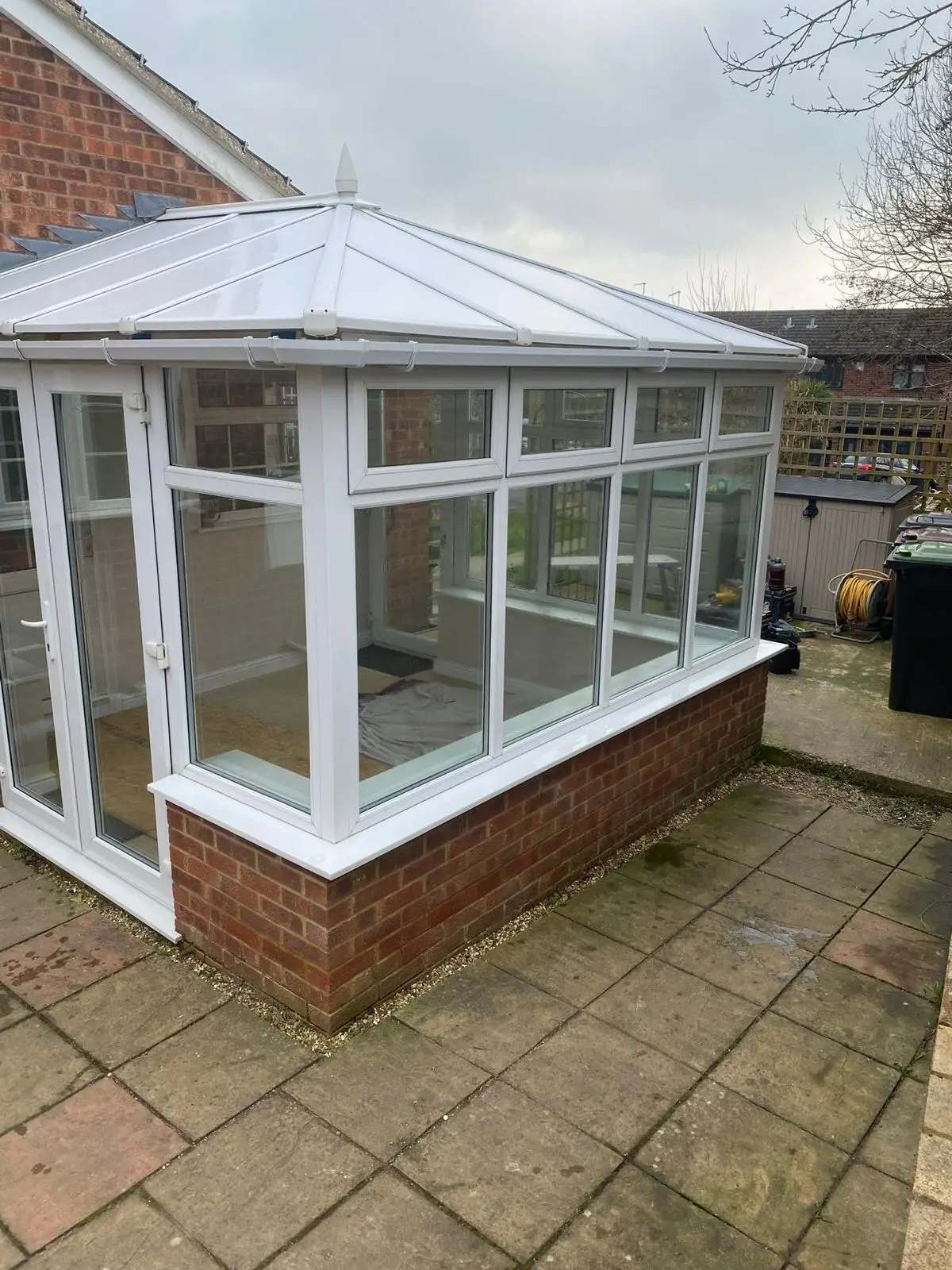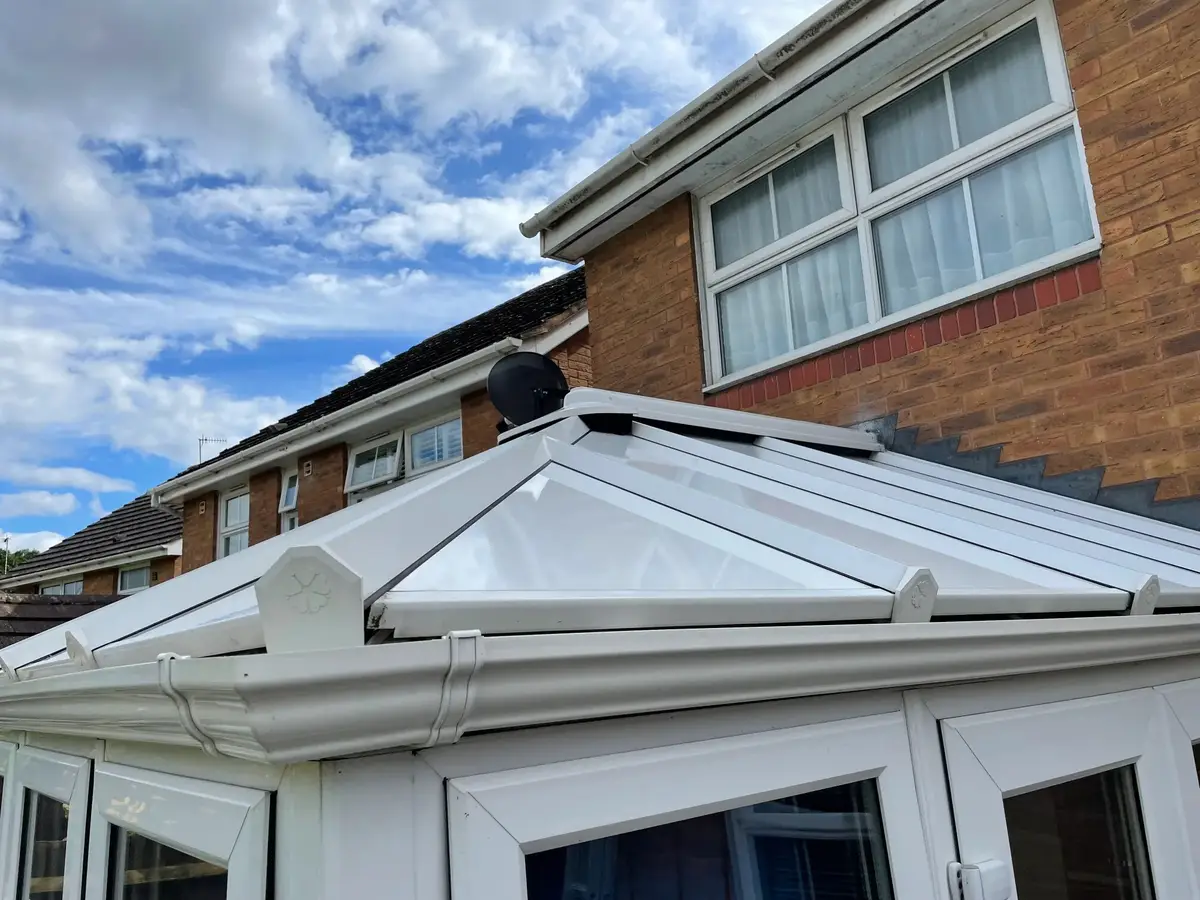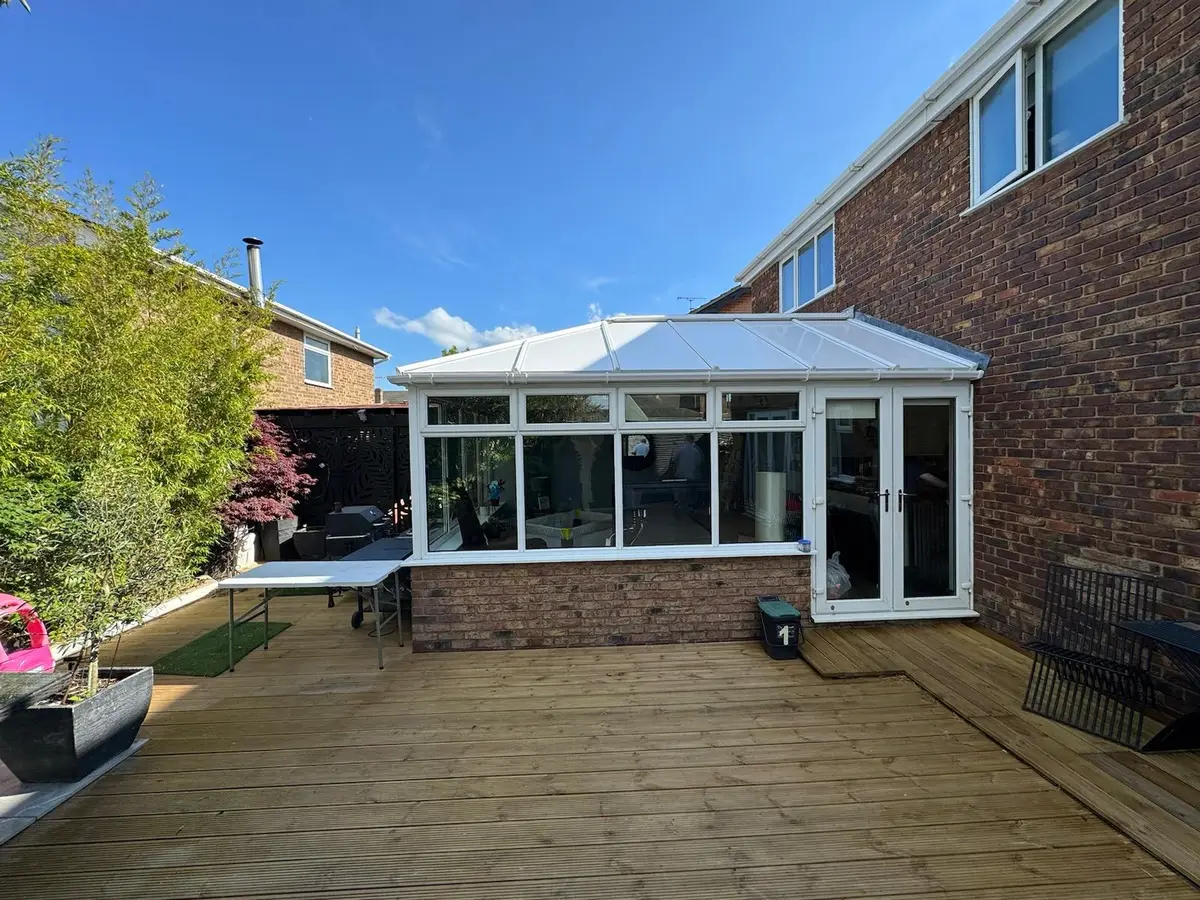
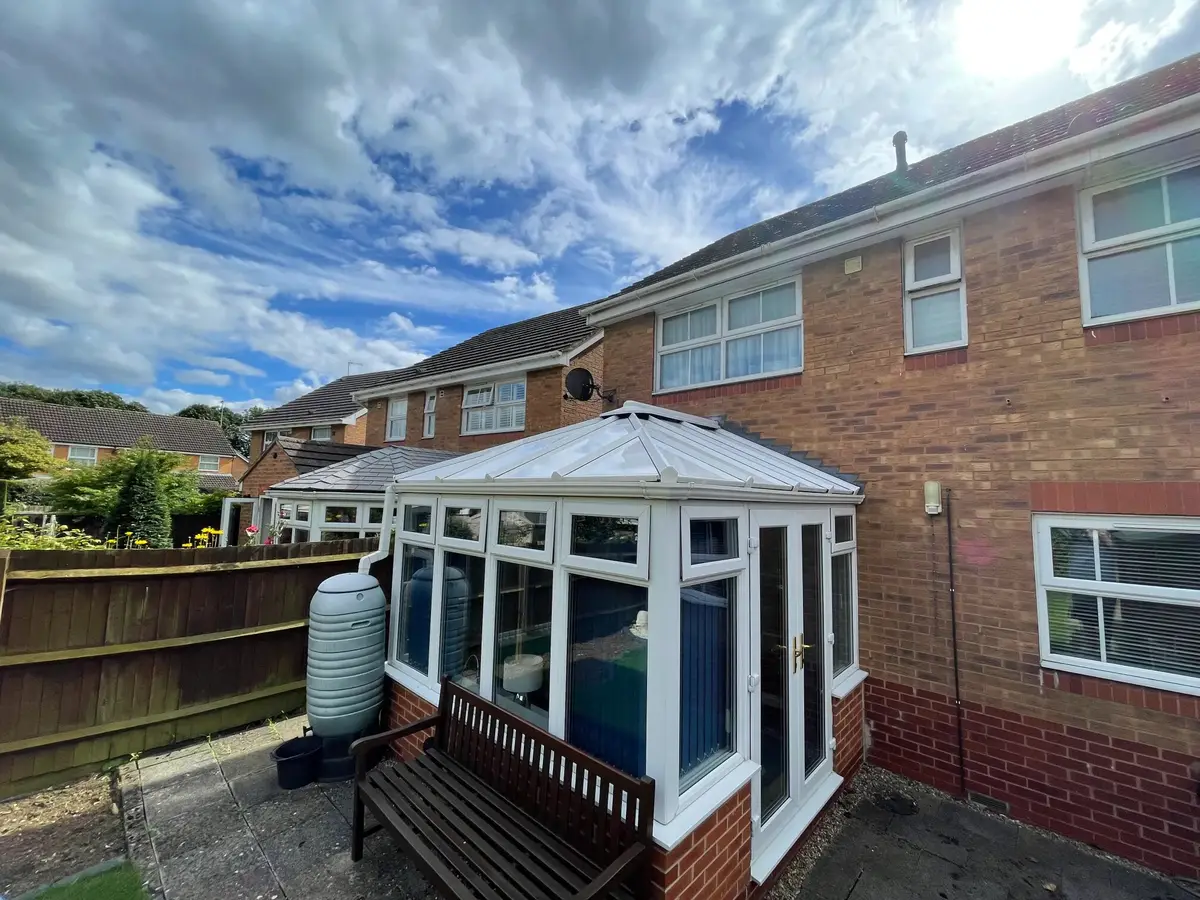
The U-value is how many watts leak through one square metre of roof per degree of temperature gap between inside and out, so a smaller figure means a warmer room. Pre-2002 double glazed roofs are near 2.8, 16 mm polycarbonate about 2.3, low-e roof glass 1.0 to 1.2, and the 75 mm panels we fit about 0.43. Building regulations set 0.15 for a new roof.
The idea in one paragraph
Every roof lets some heat through, and the U-value puts a number on how much. The unit is watts per square metre per kelvin, shortened to W/m²K. If a roof scores 2.0, each square metre passes 2 watts for every degree the room is warmer than the air outside.
From there the arithmetic is simple. Multiply the U-value by the roof area and by the temperature gap, and you have the heat loss in watts. Twice the area means twice the loss, and half the U-value means half the loss.
Smaller is better, which trips people up because most scores work the other way. A roof rated 0.4 holds heat roughly five times as well as a roof rated 2.0.
Roof types and their U-values
Every page on the Eco Tech site uses the figures below. The worked columns are for a 12 m² roof, about the size of an average lean-to or Edwardian conservatory of medium size.
| Roof type | U-value (W/m²K) | kWh lost a year | Yearly cost on electricity | Watts lost, 20°C inside and 0°C out |
|---|---|---|---|---|
| Double glazing fitted before 2002 | 2.8 | 1,734 | £456 | 672 W |
| Polycarbonate, 16 mm | 2.3 | 1,424 | £375 | 552 W |
| Polycarbonate, 25 mm | 1.6 | 991 | £261 | 384 W |
| Polycarbonate, 35 mm | 1.4 | 867 | £228 | 336 W |
| Current low-e roof glass | 1.0 to 1.2 | 619 to 743 | £163 to £196 | 240 to 288 W |
| Our 75 mm aluminium panel | 0.43 | 266 | £70 | 103 W |
| Regulations target for a new roof element | 0.15 | 93 | £24 | 36 W |
For the yearly figures we multiply U-value, area, heating degree days and 24, then divide by 1,000. England sees roughly 2,150 heating degree days a year (base 15.5°C). The pounds use 26.32p per kWh, the Ofgem electricity cap for October to December 2026. We assume the room stays warm all through the heating months. Heat it on a few evenings only and the costs shrink, though the gaps between roof types keep the same proportions.
Our own panel, worked out in the open
Each Eco Tech panel is made in the UK from two thin aluminium skins bonded either side of 75 mm of solid foam, and that foam conducts heat at 0.034 W/mK. The foam does nearly all of the insulating. The metal skins contribute so little that we leave them out.
The method is to total the resistances to heat flow, then flip the total over. Foam resistance is 0.075 / 0.034, close to 2.21. The thin layers of still air on the two faces of a roof are given a standard combined figure of 0.14. Together that makes 2.35, and 1 / 2.35 comes out at roughly 0.43 W/m²K.
We show the working so you can test it, and test other quotes the same way. Using the same foam, a 35 mm core lands near 0.86 and a 25 mm core near 1.14. Every common size is set out in our guide to how thick conservatory roof panels should be.
Is 0.43 good?
Compared with what sits on most conservatories today, it is a big step. From 16 mm polycarbonate at 2.3 down to 0.43, heat lost through the roof drops by about 80%. Starting instead with 25 mm sheet (1.6), the saving is about 73%.
The other benchmark is in the regulations. Approved Document L, the 2021 edition that took effect in June 2022, asks for 0.15 on any new roof element. Our 75 mm panel does not reach that, and we will never tell you it does.
Where building regulations come in
A conservatory stays exempt from building regulations only while it meets all of these: a roof that is 75% or more translucent, walls that are 50% or more translucent, a floor area below 30 m², external quality doors dividing it from the house, and no fixed heating run from the house's own system. A solid insulated roof breaks the first condition, so building regulations may apply, and you should check what applies to your home before work starts. For more, read how the regulations treat a solid conservatory roof.
What the U-value leaves out
Sunshine
U-values only describe heat conducted from the warm side to the cold side. Sunlight is a separate thing. A glass roof rated 1.1 still lets direct sun pour in, which is how so many conservatories reach 35 to 40°C in summer. A solid insulated roof keeps direct sun off the room, so it earns its keep in summer too.
Roof bars
Makers usually quote a centre of sheet or centre of panel figure. The uPVC or aluminium bars that hold everything up let heat through more easily, so a complete roof does slightly worse than the headline number. That is true for all roof types, so the ranking does not change.
The rest of the room
Glazed walls, the floor and gaps round doors lose heat as well. Because the roof faces the open sky and is usually the biggest single surface, changing it brings the largest single gain, but it is one part of the picture.
Wet mornings
A lower U-value means a warmer inner face. On a freezing night the underside of 16 mm polycarbonate falls far below room temperature, and that is why it drips. A panel's inner skin stays near room temperature, so the dripping largely stops. See our page on stopping conservatory roof condensation for the dew point figures.
Three questions for any U-value on a quote
- Does it apply to the complete roof, or only the middle of a sheet or panel?
- Which core material and thickness is it based on?
- Was it calculated or tested, and will they show you how?
When a number seems too low for the thickness, ask where it came from. Foam of this kind only insulates in proportion to its depth, so a slim panel claiming a tiny U-value needs checking.
Putting the numbers to use
Try the roof price calculator for your size, or read how our insulated roof panels are put together. When you ask Eco Tech for a free quote, the panel specification and its U-value are written on it.
Questions people ask
How well does a polycarbonate conservatory roof insulate?
Its U-value is roughly 2.3 at 16 mm, 1.6 at 25 mm and 1.4 at 35 mm. Each of those is several times worse than an insulated panel roof.
What U-value does a glass conservatory roof have?
Double glazed roofs from before 2002 are near 2.8. Current low-e roof glass sits at about 1.0 to 1.2.
Do Eco Tech panels reach the 0.15 target in the regulations?
No. Our 75 mm panel is roughly 0.43, and we will not claim anything else.
Is the lowest U-value always the best choice?
For holding heat in, yes. It ignores summer sunshine, though, so a solid insulated roof also beats glass on hot days in a way the U-value cannot show.